
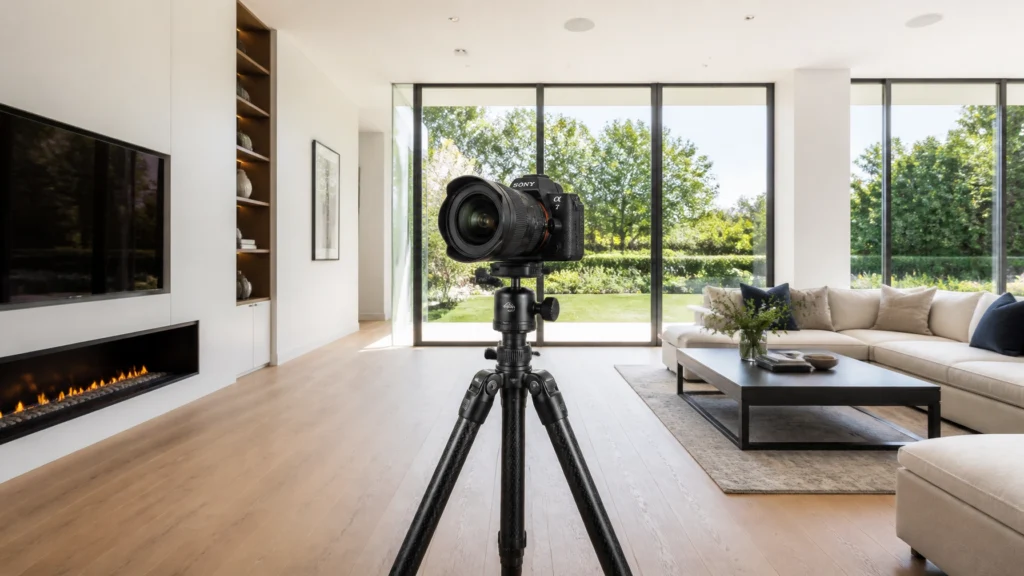
If you’ve been in the real estate media game for a while, you know that gear comes and goes. Every few months, there’s a new “game-changer” hitting the market. But after 14 years and over 10,000 homes photographed, I’ve learned that the “best” camera isn’t always the newest one, it’s the one that helps you shoot faster, deliver higher quality, and keep your business profitable.
For years, the Sony A7 IV was the backbone of my business. It was the primary camera I used every single day before the A7 V eventually landed in my bag. Even now, in 2026, I get asked the same question by photographers starting out or looking to upgrade: “Is the Sony A7 IV still worth it?”
The short answer is a resounding yes.
In this guide, I’m going to break down exactly why this camera remains a powerhouse for real estate media, how it fits into a high-efficiency workflow, and whether you should pick one up today or look elsewhere.
Quick Verdict: The Real Estate Workhorse
The Sony A7 IV is the definitive “goldilocks” camera for real estate photographers in 2026. It offers the perfect balance of resolution (33MP), dynamic range, and professional video features at a price point that makes sense for a growing business. While the A7 V has some fancy AI tricks, the A7 IV delivers 95% of the performance for a fraction of the cost.
Who is it for? Professional real estate photographers who want a reliable, full-frame workhorse that handles both high-end stills and social media video with ease.
Worth buying today? Absolutely. Especially if you’d rather spend the price difference on a top-tier wide-angle lens.
Why I Recommend the Sony A7 IV
When I recommend gear, I’m not looking at spec sheets in a vacuum. I’m thinking about that 4:00 PM shoot on a gloomy Tuesday when you’re tired, the house is a mess, and you need to get in and out in 45 minutes while still delivering “wow” photos to your client.
I recommend the A7 IV because it is consistent. In this business, consistency is how you build a brand. Whether I was shooting a $200k condo or a $10M lakefront estate, the A7 IV produced predictable, high-quality RAW files that fit my AutoHDR workflow perfectly.
It’s durable, too. Mine has been through thousands of battery cycles, countless lens changes in dusty driveways, and the occasional bump against a doorframe. It never skipped a beat. For a professional, reliability isn’t a luxury, it’s a requirement.

Key Features That Matter for Real Estate
Let’s ignore the features designed for bird watchers or wedding photographers. Here is what actually matters when you’re standing in a kitchen:
1. 33MP Full-Frame Sensor
In real estate, 24MP is the baseline, but 33MP is the sweet spot. It gives you enough resolution to crop in slightly if your composition wasn’t perfect, or to produce high-quality prints for luxury brochures, without creating the massive, slow-to-edit files you get from 60MP cameras like the A7R series.
2. Exceptional Dynamic Range
This is the “secret sauce” for those crisp window views. The A7 IV has incredible latitude in the RAW files. When I’m shooting brackets, I can recover details in the deepest shadows of a dark basement and the brightest highlights of a sun-drenched window with minimal noise.
3. Reliable 5-Step Bracketing
For my Handheld HDR Guide techniques, the A7 IV is a dream. It allows for fast, continuous bracketing (0.7EV or 2.0EV steps) that makes capturing the full light range of a room incredibly efficient.
4. Improved Ergonomics and Menu System
If you used the older A7 III, you know the menus were a nightmare. The A7 IV introduced the modern Sony menu system and a better grip. When you’re shooting 5 houses a day, how the camera feels in your hand and how fast you can change a setting matters.
Real-World Performance: Inside the Home
Let’s talk about a typical day. I arrive at a listing, 15 minutes early as always. I’ve got my Sony A7 IV, a 16-35mm wide-angle lens, and a sturdy tripod.
The Tripod Workflow
For high-end luxury shots, I’m on a tripod. I set my ISO to 100, Aperture to f/8.0, and use the A7 IV’s built-in self-timer or a remote trigger. The 33MP sensor captures the fine textures of the granite countertops and the grain in the hardwood floors with clinical precision. Because the vertical lines stay perfectly straight (thanks to the EVF’s electronic level), my post-processing time is cut in half.
The Handheld “Speed” Workflow
This is where the A7 IV really shines. If I’m shooting a high-volume “standard” listing, I switch to handheld. The In-Body Image Stabilization (IBIS) combined with the fast autofocus means I can walk through a home and capture a full set of HDR brackets in 15-20 minutes. I’m not fumbling with tripod legs in tight bathrooms or hallways.
The autofocus is “sticky”, it locks onto a feature in the room and doesn’t hunt, even in low-light dining rooms. This reliability is why I could shoot 10,000 homes without going crazy.
Workflow Advantages: Shooting Faster, Earning More
The RE Media Systems mission is to help you build a better business. Gear should be an investment that pays for itself through efficiency.
- Fast Card Writing: The dual card slots (including support for CFexpress Type A) mean the camera never “buffers” while you’re shooting fast brackets. You move as fast as the camera does.
- AutoHDR Integration: The RAW files from the A7 IV play incredibly well with modern AI editing tools. Whether you outsource your editing or use an automated system, the colors are neutral and easy to balance.
- Battery Life: I can usually get through 2-3 standard shoots on a single NP-FZ100 battery. That means fewer interruptions and less gear to carry.

Video Performance: Beyond the Stills
In 2026, you aren’t just a photographer; you’re a media creator. Clients want property walkthroughs, Reels, and TikToks.
The A7 IV is a beast for video:
- 4K 60p: Perfect for those slow, cinematic glides through a living room.
- 10-bit 4:2:2 Color: Gives you tons of flexibility in color grading to make the grass look greener and the sky look bluer.
- Active Stabilization: Allows for incredibly smooth handheld “walk-and-talk” videos if you don’t have your gimbal handy.
- Flip-out Screen: Essential for filming agent intros or social media content.
Build Quality: Built for the Grind
I’ve used this camera in -30°C Saskatchewan winters and 35°C humid summers. It’s weather-sealed and feels solid. The shutter is rated for hundreds of thousands of actuations. When you buy an A7 IV, you aren’t buying a toy; you’re buying a professional tool that can handle the daily grind of a full-time real estate media business.
Comparison: Sony A7 IV vs. The Competition
| Feature | Sony A7 IV | Sony A7 V | Sony A7 III | Sony a6700 |
|---|---|---|---|---|
| Sensor | 33MP Full Frame | 33MP Full Frame (AI) | 24MP Full Frame | 26MP APS-C |
| Autofocus | Excellent | Next-Gen AI | Good | Excellent AI |
| Stabilization | 5.5 Stops | 8.0 Stops | 5.0 Stops | 5.0 Stops |
| Video | 4K 60p (10-bit) | 4K 60p (AI Enhanced) | 4K 30p (8-bit) | 4K 120p (10-bit) |
| Best For | Professional Workhorse | High-Volume Video Pros | Beginners on a Budget | Compact/Hybrid Users |
Who Should Buy the Sony A7 IV?
- The New Professional: If you are transitioning from a hobbyist to a pro, this is the best investment you can make to ensure your work looks top-tier from day one.
- The Upgrader: If you are currently shooting on a crop-sensor (like an a6000 series) or an older DSLR, the jump in dynamic range and low-light performance will be massive.
- The Budget-Conscious Pro: Since the A7 V is now the “flagship” mid-range, the A7 IV can be found at great prices on the used market, allowing you to invest more in Best Lenses for Real Estate Photography.
Who Should Skip It?
- The Purely High-End Video Pro: If 80% of your business is high-end video, the A7 V or even the A7S III might be better for the extra stabilization and frame rates.
- The “Lighter is Better” Photographer: If you prioritize weight above all else, the Sony a6700 is a phenomenal APS-C alternative that packs a lot of punch in a smaller body.
Pros & Cons
Pros
- Incredible Image Quality: The 33MP sensor is the sweet spot for the industry.
- Versatility: It handles stills, video, and floor plans equally well.
- Lens Ecosystem: Sony has the widest selection of native and third-party wide-angle lenses (Sigma, Tamron).
- Resale Value: Even in 2026, these cameras hold their value well.
Cons
- 4K 60p Crop: It has a slight crop in 4K 60p video, which means you need a wider lens (like a 12-24mm) to get the same look as 4K 30p.
- No Dedicated AI Chip: Unlike the newer A7 V, it lacks the specialized AI processing for subject recognition, though for stationary houses, this rarely matters.
Recommended Accessories for the A7 IV
To get the most out of your A7 IV, don’t just buy the body. You need the right support system:
- Lenses: The Sony 16-35mm f/4 PZ G is my go-to for its light weight and power zoom features.
- Memory Cards: Stick with high-speed V60 or V90 SD cards for reliability.
- Tripod: A carbon fiber tripod is a lifesaver for your back. See my Tripod Recommendations.
- Bag: An organized Camera Bag ensures you never leave a battery or SD card behind.
FAQ: Buying the Sony A7 IV in 2026
1. Is 33MP enough for high-end luxury real estate?
Yes. Most real estate images end up on the MLS (resized to 2-3MB) or on Instagram. 33MP provides plenty of detail for even the most demanding high-end clients and print brochures.
2. How does the A7 IV handle low-light interiors?
Excellently. Because it’s a full-frame sensor, the noise levels are very low at ISO 400-800, which is where you might find yourself if you’re shooting handheld in a dark room.
3. Should I buy it new or used?
In 2026, the used market is flooded with great-condition A7 IVs from people upgrading to the A7 V. If you can find one with a low shutter count, buy it used and save $800+.
4. Can I use it for virtual tours?
Absolutely. While we often use dedicated 360 cameras for speed, you can shoot high-resolution panoramas with the A7 IV and stitch them for ultra-high-quality virtual tours.
5. Does it overheat during long video shoots?
It’s much better than the A7 III. With the screen flipped out, I’ve never had it overheat during a standard 30-60 minute property shoot.
6. Is the autofocus fast enough for real estate?
It’s overkill. Real estate photography is mostly about static subjects. However, the eye-AF is great if you’re filming an agent’s “talking head” intro.
7. Does it have a built-in level?
Yes, the electronic level in the viewfinder is a lifesaver for keeping your vertical lines straight on-site.
8. What is the best wide-angle lens for this camera?
The Sony 16-35mm f/4 PZ G is the best all-arounder, but the Sony 12-24mm f/4 G is better for tight bathrooms and small spaces.
9. How many card slots does it have?
Two. I always set mine to “Simultaneous Record” so I have an instant backup of every photo I take.
10. Is the A7 V worth the extra money?
Only if you do a lot of handheld video and really need that extra 2.5 stops of stabilization or the AI-assisted autofocus. For 90% of real estate work, the A7 IV is the smarter financial choice.
Final Recommendation
The Sony A7 IV isn’t just a camera; it’s a business tool. After 14 years in this industry, I’ve seen cameras come and go, but the A7 IV is one of those rare models that stays relevant for a long time. It delivers exactly what a real estate photographer needs: speed, reliability, and professional image quality.
If you want a camera that will help you shoot faster, earn more, and build a better media business, the Sony A7 IV is still my top recommendation in 2026.