
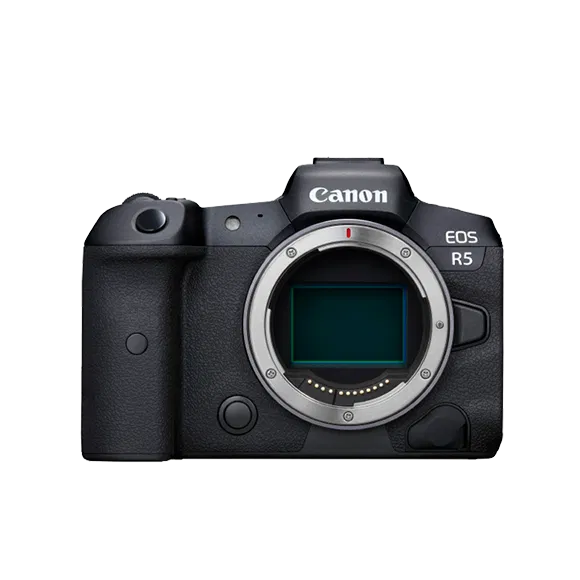
1. Quick Verdict
Is the Canon EOS R5 recommended? Yes, but with a caveat.
Who is it for? High-end real estate media professionals who need maximum resolution for print, large-scale cropping for social media, and top-tier 4K/8K video capabilities for luxury listings.
Worth buying today? Absolutely. Even as newer models emerge, the R5 remains a powerhouse that holds its value and delivers “client-wowing” results. However, if you are strictly shooting entry-level residential listings, it might be more tool than you actually need.
2. Why I Recommend This Camera
After photographing over 10,000 homes across 14+ years, I’ve seen gear come and go. I’ve lived through the transition from DSLRs like the 5D Mark IV to the mirrorless revolution. In my workflow at RE Media Systems, we prioritize two things: Speed and Consistency.
The Canon EOS R5 earned its spot in my bag because it solves a specific set of problems. In the past, we had to choose between a high-resolution “stills” camera and a dedicated “video” camera. The R5 was one of the first bodies that truly mastered both without compromise. When you’re walking through a $5M mansion, you don’t want to be swapping bodies between the kitchen photos and the cinematic video walkthrough. The R5 handles the transition seamlessly, allowing me to deliver a premium product without slowing down the shoot.
I recommend this camera not just for its specs, but for its reliability. In a high-volume business, your camera is a hammer. It needs to work every single time you pull it out of the bag. The R5 is that hammer.
3. Key Features That Matter for Real Estate
When you look at a spec sheet, it’s easy to get distracted by 8K RAW or 20fps burst rates. For real estate, most of that is noise. Here are the features that actually make a difference when you’re standing in a dark living room trying to balance a bright window view:
45-Megapixel Full-Frame Sensor
Wait, don’t most MLS systems downsize images to 2MB? Yes. But the 45MP sensor isn’t about the final output size; it’s about flexibility.
- Cropping: You can shoot a wide-angle shot of a master suite and crop in for a “detail shot” of the fireplace without losing professional-grade sharpness.
- Vertical Content: You can shoot horizontally and crop a high-quality vertical 9:16 video or photo for Instagram Reels and TikTok without the image falling apart.
5-Axis In-Body Image Stabilization (IBIS)
The R5 offers up to 8 stops of shake correction when paired with certain RF lenses. For real estate, this is a game-changer for “scout shots” or quick detail captures where you don’t want to set up a tripod. It also makes handheld video walkthroughs significantly smoother.
Advanced HDR Bracketing
Canon’s menu system remains the most intuitive for setting up 3, 5, or 7-shot brackets. The R5 handles these sequences incredibly fast, minimizing the time between shots, which is vital when you’re trying to beat the setting sun or working around a busy homeowner.
Dual Pixel CMOS AF II
The autofocus on the R5 is sticky. It finds architectural lines and holds them. Even in low-light basements, the AF rarely hunts, ensuring every frame in your bracket is tack-sharp.
4. Real-World Performance: In the Field
What is it actually like to use the Canon EOS R5 for Real Estate Photography?

The Window Test
One of the hardest parts of our job is capturing the view outside a window while keeping the interior bright. The R5’s dynamic range is exceptional. When I pull the RAW files into Lightroom, I find I have significantly more “recovery room” in the shadows and highlights than I did with the older 5D series. This means cleaner HDR blends and less “muddy” shadows.
High-Volume Reliability
On a typical day, I might shoot 5 to 7 homes. That’s hundreds of brackets and dozens of video clips. The R5’s ergonomics, the grip, the button placement, and the articulating screen, mean less physical fatigue. The screen is particularly important; when your camera is jammed into a corner or high up on a tripod to get a specific angle, being able to flip that screen out is the difference between getting the shot and guessing.
Heat Management (The Video Elephant in the Room)
Early reviews of the R5 complained about overheating in 8K. Let’s be real: for real estate, you are rarely, if ever, shooting 30 minutes of continuous 8K. For 60-second cinematic clips in 4K 60fps, I have never had the R5 overheat on a property. It is a non-issue for our industry.
5. Workflow Advantages: Earning More by Shooting Faster
At RE Media Systems, our mission is to help you shoot faster and earn more. The R5 contributes to this in several ways:
- Reduced Editing Time: The colors out of the R5 are classic Canon, warm, accurate, and pleasing to the eye. I find myself doing less color correction on “Canon Yellow” or “Sony Green” than with other systems.
- The “One-Take” Video: With the R5’s excellent IBIS and AF, I can often nail a video move in one take. Over 10,000 homes, saving 2 minutes per room adds up to weeks of your life back.
- Client Perception: Whether we like it or not, clients judge us by our gear. Walking in with a professional-grade R5 and a 14-35mm L-series lens signals to the agent and the homeowner that they are getting a premium service. This justifies your higher price point.
6. Pros
- Resolution: 45MP allows for massive prints and aggressive cropping.
- Autofocus: Best-in-class subject and eye tracking (great for lifestyle real estate shots).
- Ergonomics: Intuitive menus and a comfortable physical build.
- Lens Ecosystem: Access to the RF 14-35mm f/4L, arguably the best real estate lens ever made.
- Video Quality: 4K 120fps for beautiful slow-motion details of water features or luxury amenities.
7. Cons
- Price: It’s a significant investment compared to the R6 II or R8.
- File Size: 45MP files take up more hard drive space and require a faster computer for editing.
- Storage: You’ll need expensive CFexpress Type B cards to unlock the best video features.
- Overkill for some: If you only do $200k condos, the R5 is like driving a Ferrari to the grocery store.
8. Who Should Buy This Camera?
- The Luxury Specialist: If your brand is built on $1M+ listings, you need the resolution and video specs the R5 provides.
- The Hybrid Shooter: If you provide both high-end stills and high-end video, this is the best single-body solution in the Canon lineup.
- The “Crop Enthusiast”: If you want to create social media content from your horizontal stills without losing quality.
9. Who Should Skip It?
- The High-Volume “Budget” Photographer: If your business model is based on $125 shoots and high volume with quick turnarounds, the Canon R6 Mark II is a much smarter financial move.
- Beginners: Start with a Canon R10 or R8. Learn the systems before dropping $3,000+ on a body.
10. Recommended Accessories
To get the most out of the R5 for real estate, you need the right support gear. Check out our Recommended Gear Page for the full list, but here are the essentials:
- Lens: Canon RF 14-35mm f/4L IS USM. This is the gold standard for interiors.
- Memory: At least one 512GB CFexpress Type B card and a high-speed SD card for backup.
- Power: Extra LP-E6NH batteries. Mirrorless cameras eat power faster than DSLRs.
- Tripod: A sturdy carbon fiber tripod with a geared head for precise architectural alignment.

11. Alternatives
Canon R5 vs. Canon R6 Mark II
The R6 II is the “little brother” that is often the smarter buy.
- R6 II: 24MP, cheaper, lighter, better battery life, and arguably better in extremely low light because of the lower pixel density.
- R5: 45MP, better build quality, 8K video, and a top-down LCD screen.
- The Verdict: If you don’t need to print 40-inch canvases or crop 400% into your photos, save the $1,500 and get the R6 II.

Canon R5 vs. Sony A7R V (or A7 V)
This is the “Ford vs. Chevrolet” debate of our time.
- Sony A7R V: 61MP, incredible AI-based autofocus, and a unique 4-axis multi-angle screen that many real estate photographers prefer.
- Canon R5: Better ergonomics (for most), better “out of camera” colors, and a slightly more user-friendly menu system.
- The Verdict: If you are already in the Canon ecosystem, stay with the R5. If you are starting from scratch, the Sony A7R V offers more megapixels, but the Canon RF lenses are currently slightly ahead for architectural work.
12. FAQ: Canon EOS R5 for Real Estate
1. Does the R5 overheat when shooting real estate video?
No. For the short clips (10-30 seconds) used in property walkthroughs, it stays perfectly cool.
2. Are 45 megapixels too many for the MLS?
Yes, for the final upload. But they are perfect for cropping and marketing materials. You can always downsize, but you can’t “up-size” detail that isn’t there.
3. Do I need CFexpress cards for stills?
No, you can shoot stills to a standard SD card (V30 or V60). You only need CFexpress for high-bitrate video or high-speed bursts.
4. How is the battery life on the R5?
It’s decent, but not DSLR-level. Expect to change batteries every 2-3 shoots. Always carry two spares.
5. Is the RF 15-35mm f/2.8 better than the 14-35mm f/4?
For real estate, no. The 14-35mm f/4 is wider (14mm is huge for small bathrooms) and cheaper. You’re usually shooting at f/8 on a tripod anyway, so you don’t need the f/2.8.
6. Can I use my old EF lenses on the R5?
Yes, with the EF-EOS R adapter. They work perfectly, often better than they did on DSLRs because of the mirrorless AF system.
7. Is the R5 good for virtual tours (like Matterport)?
It’s great for high-resolution 360 photography if you use a pano-head, but it’s overkill if you’re just using it to trigger a camera on a motor.
8. Should I wait for the R5 Mark II?
In 2026, the R5 is a mature, stable platform. Unless the Mark II offers a feature that directly solves a problem you have today, the current R5 is a better value.
9. Does the R5 have built-in GPS?
No, you have to use the Canon app or an external receiver to geotag.
10. Is the R5 weather-sealed?
Yes, it has professional-grade sealing. While we don’t shoot interiors in the rain, it’s great for those “gloomy day” exterior shots.
13. Final Recommendation
The Canon EOS R5 is a professional’s tool. If you are serious about building a high-end real estate media business, this camera will not only keep up with you but will push you to deliver better work.
However, if you are just starting out, don’t feel like you must have the R5 to be successful. A skilled photographer with a Canon R10 can out-shoot a beginner with an R5 every day of the week. Focus on your lighting, your composition, and your systems first. When your business grows to the point where your gear is the bottleneck, that’s when you buy the R5.
Ready to upgrade your gear?
- Check out my Full Recommended Gear List.
- Watch my video review of the R5 on YouTube.
- Explore more guides in our Gear & Tools blog.
RE Media Systems Mission: Helping you shoot faster, earn more, and build a better real estate media business.