
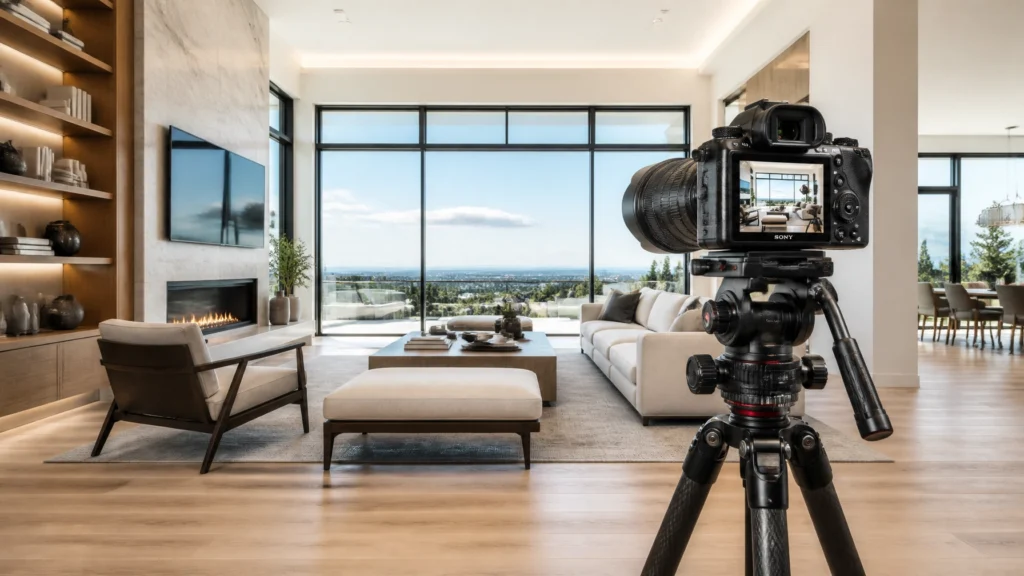
After photographing more than 10,000 homes over the last 14 years, I’ve learned one very expensive lesson: Gear is either a tool that makes you money or a toy that costs you money.
In the early days of RE Media Systems, I was obsessed with having the latest and greatest everything. I thought a sharper lens or a higher megapixel count would magically attract better clients. I was wrong. What actually attracts better clients, and more importantly, keeps them, is your ability to deliver high-quality work, consistently, and fast.
In 2026, the real estate media landscape is more competitive than ever. We aren’t just “photographers” anymore; we are media providers offering video, drones, floor plans, and virtual tours. If your gear doesn’t help you shoot faster or earn more per hour, it’s a liability.
This guide isn’t just a list of specs. It’s a roadmap for building a profitable gear kit that grows with your business. Whether you’re shooting your first condo or scaling a multi-photographer team, here is exactly what you need in your bag.
1. The Camera Body: The Engine of Your Business
The most common question I get is, “Scott, what camera should I buy?” My answer is always: the one that gets out of your way.
In 2026, the “Big Three” (Sony, Canon, Nikon) have reached a point where any professional mirrorless body will produce incredible results. However, for real estate, we care about three specific things: Dynamic Range, Bracketing Speed, and Battery Life.
Full-Frame vs. APS-C
If you are serious about scaling, go full-frame. While APS-C (crop sensor) cameras like the Sony a6700 or Canon R10 are great budget starters, full-frame sensors handle the extreme contrast of window pulls and dark corners significantly better. You want those extra stops of dynamic range to save time in post-production.
Top Recommendations for 2026
- The Industry Standard: Sony A7 IV / A7 V
I’ve been a Sony shooter for years because their autofocus and lens ecosystem are unmatched. The Sony A7 IV is still a workhorse, but the Sony A7 V is the new gold standard for 2026. Its AI-driven processing helps with white balance consistency, which is a massive time-saver. - The Hybrid King: Canon R6 II
If you do a lot of video, the Canon R6 II is a beast. Canon colors are beautiful straight out of the camera, and their EOS R5 remains a top-tier choice for high-resolution luxury work. - The Rugged Choice: Nikon Z6 III
Nikon has made a massive comeback. The Z6 III is incredibly reliable and the Z-mount lenses are some of the sharpest on the market.
Scott’s Take: I currently use the Sony A7 V. The ability to customize buttons for my specific HDR workflow means I can shoot an entire 3,000 sq. ft. home in under 45 minutes without ever looking at a menu.
2. The Lens: Your Most Important Investment

If you have $2,000 to spend, spend $500 on a body and $1,500 on a lens. The lens defines the “look” of your business more than the camera does.
The 16-35mm Workhorse
For real estate, the 16-35mm wide-angle zoom is your primary tool. It’s wide enough to make small bathrooms look spacious but versatile enough to zoom in for “vibe” shots of kitchen details.
One lesson I’ve learned: You do not need an f/2.8 lens for real estate. We almost always shoot at f/8 or f/11 to keep everything in focus. Save your money and buy the f/4 version (like the Sony 16-35mm f/4 PZ). It’s lighter, cheaper, and just as sharp at the apertures we actually use.
Why Avoid “Too Wide”?
I see beginners shooting at 10mm or 12mm on full-frame. Please, don’t do this. It creates “funhouse” distortion where the edges of the room look like they are melting. Stick to 16mm or 17mm for a natural, professional look.
3. The Tripod & Geared Head: The Most Underrated Gear

In 14 years, I’ve seen more photographers struggle with crooked vertical lines than anything else. A standard ball head is great for landscapes, but it’s a nightmare for real estate.
Why You Need a Geared Head
A geared head (like the Manfrotto 410 or the Benro GD3WH) allows you to make micro-adjustments to your pitch, roll, and yaw independently. Instead of fighting a ball head to get your camera perfectly level, you simply turn a knob.
The ROI: It saves you 5-10 minutes per shoot in setup time and another 10 minutes in post-production because you aren’t constantly fixing “keystoning” (tilted walls) in Lightroom.
The Tripod
Go for carbon fiber. It’s lighter to carry around all day and absorbs vibrations better than aluminum. I recommend the Manfrotto 055 Carbon Fiber or a sturdy Benro alternative.
4. Drone Gear: Taking Your Business to New Heights
In 2026, drone photography is no longer an “add-on”: it’s expected. If you aren’t offering aerials, you are leaving thousands of dollars on the table every year.

Recommended Drones
- The Professional Choice: DJI Air 3
This is my current favorite. The dual-camera system allows you to get wide property shots and zoomed-in detail shots without having to fly closer to the house. - The High-End Choice: DJI Mavic 3 Pro
If you are shooting luxury estates or commercial properties, the Hasselblad sensor on the Mavic 3 Pro is unbeatable for color and detail.
5. Video & Social Media: The “Vertical” Revolution
The way agents market homes has shifted. In 2026, a 3-minute horizontal “cinematic” tour is often less valuable than a 30-second vertical Reel or TikTok.
The Vertical Kit
- The iPhone 15/16 Pro: Honestly, for social media reels, a modern iPhone on a small gimbal is often faster and “better” for the platform than a mirrorless camera.
- The Gimbal: If you are using your mirrorless camera for video, the DJI RS3 or RS4 is essential. It provides that smooth, walking-through-the-home feel that buyers love.
Check out our guide on Mastering Vertical Video to see how we integrate this into our daily workflow.
6. Lighting: Speed vs. Quality
The “Flambient” (Flash + Ambient) vs. “HDR” (High Dynamic Range) debate is as old as the industry.
- My Preference (HDR): I shoot 90% of my homes using HDR. Why? Because it’s faster. With modern AI editing tools, we can get “flambient-like” results in half the time. Shooting faster allows me to fit 5–6 homes in a day instead of 3.
- When to use Flash: I still carry a Godox AD200 for high-end luxury shoots or rooms with terrible “mixed lighting” (orange bulbs mixed with blue daylight).
If you want to master the speed-focused approach, read my Guide to Professional HDR.
7. Software & Business Gear: The Invisible Tools
Your gear isn’t just hardware. The software you use is the “connective tissue” that turns photos into a business.

- CubiCasa: This is the most important app on my phone. It allows me to scan a floor plan in 5 minutes while I’m already walking the house. It’s an instant $50–$100 upsell per shoot.
- HDPhotoHub: This is how I manage my business. It handles booking, delivery, and payments. I don’t release photos until the client pays, which solved my “chasing checks” problem years ago.
- AI Editing: We use AI-assisted editing to handle the heavy lifting of HDR blending. This allows us to maintain a 24-hour turnaround without staying up until 2 AM.
8. Budget Tiers: What Should You Spend?
I’ve categorized these kits based on where you are in your journey. Remember, the goal is to move up the tiers using the profits from your shoots, not your credit card.
Starter Kit ($1,500 – $2,500)
Ideal for: Part-time beginners or photographers transitioning from other niches.
- Body: Sony a6700 or Canon R10
- Lens: Sony 10-18mm or Canon RF-S 10-18mm
- Tripod: Benro Aluminum with a standard ball head (upgrade to geared soon!)
- Drone: DJI Mini 4 Pro (No Part 107 license required in some regions, but get it anyway!)
Professional Kit ($4,000 – $6,000)
Ideal for: Full-time solo operators shooting 10+ homes a week.
- Body: Sony A7 IV or Canon R6 II
- Lens: 16-35mm f/4 (Sony PZ or Canon RF)
- Tripod: Carbon Fiber with Geared Head (Benro GD3WH)
- Drone: DJI Air 3
- Misc: Godox V1 Flash, CubiCasa subscription.
Scaling / High-End Kit ($10,000+)
Ideal for: Luxury specialists or media companies with teams.
- Body: Sony A7 V or Canon R5 II
- Lens: 16-35mm f/2.8 GM II (for that extra bit of sharpness)
- Tripod: Gitzo Carbon Fiber with Manfrotto 405 Geared Head
- Drone: DJI Mavic 3 Pro
- Lighting: Godox AD200 Multi-light setup
- Video: DJI RS4 Pro Gimbal + Ninja V Monitor.
9. The “What to Buy First” Roadmap

If I were starting over today with $5,000 in the bank, here is the exact order I would buy things:
- A Full-Frame Body & 16-35mm Lens: You can’t start without the core.
- A Carbon Fiber Tripod & Geared Head: This ensures your quality is “pro” from day one.
- A DJI Air 3: This allows you to immediately offer “Premium Packages.”
- A CubiCasa Account: This is the fastest way to increase your Average Order Value (AOV).
- Marketing & Business Systems: Before buying a second lens, spend money on Client Acquisition and Pricing Strategies.
Conclusion: It’s Not About the Camera
At the end of the day, your client doesn’t care if you shot on a Sony or a Canon. They care that their listing went live on time, looked beautiful, and helped them sell the house.
Gear is a means to an end. Use this guide to build a kit that is reliable, efficient, and profitable. Once you have the right tools, stop worrying about the gear and start worrying about the business systems that will actually help you scale.
Ready to take the next step?
- Check out our Recommended Gear Page for direct links to the latest deals.
- Join our newsletter for weekly tips on how to shoot faster and earn more.
- Watch our YouTube channel for “Behind the Scenes” videos of these tools in action on real listings.
Keep shooting, keep scaling.
: Scott Prokop
Founder, RE Media Systems