In my 14 years shooting homes, I’ve seen the industry survive the transition from film to digital, the rise of HDR, and the explosion of drone photography. But nothing has moved as fast, or caused as much legal anxiety, as the arrival of Generative AI.
I’ve personally shot over 10,000 homes. Back in 2012, if I wanted to “remove a car” from a driveway, it took twenty minutes of meticulous cloning in Photoshop. Today, I can do it in four seconds with a text prompt.
That speed is a superpower for us as photographers, but it’s become a massive liability for real estate agents. As of June 2026, the “Wild West” era of AI editing is officially over. Between the National Association of Realtors (NAR) tightening their Code of Ethics and landmark state laws like California’s AB 723 taking full effect, we are now in an era of mandatory transparency.
If you’re a photographer thinking, “This is the agent’s problem,” you’re missing a huge opportunity. By understanding these laws and building disclosure into your workflow, you aren’t just a “picture taker”, you become a risk-management partner for your clients.
Here is everything you need to know about navigating the new AI regulatory landscape without slowing down your business.
The New Regulatory Landscape: Why “Wait and See” is Not a Strategy
By early 2026, the conversation shifted from “Can we use AI?” to “How do we disclose it?” The primary drivers are consumer protection and the prevention of misrepresentation.
The biggest hammer in the room right now is California’s Assembly Bill 723 (AB 723). Even if you aren’t shooting in California, pay attention. Historically, California’s real estate laws tend to migrate across the country within 18 to 24 months.
The Core Requirements of 2026:
- Mandatory Disclosure: Any image that has been digitally altered to add, remove, or modify physical features of a property must be clearly disclosed.
- Access to Originals: In many jurisdictions, you must now provide the original, unaltered photo alongside the edited one (either directly before/after in the gallery or via a conspicuous link/QR code).
- Strict Liability: Agents are responsible for what they post, but photographers can be held liable in civil court if their marketing materials lead to a fraud claim where the photographer knowingly misrepresented the property.
Ignoring these rules doesn’t just result in an MLS fine; in some states, it’s now being treated as a misdemeanor form of deceptive advertising.
Defining the Line: AI-Assisted vs. AI-Generated
One of the most common questions I get from photographers in my coaching program is: “Do I have to disclose every time I use AI to fix the white balance or sharpen an image?”
The short answer is no.
The law distinguishes between Assisted Editing (which is fine) and Material Alteration (which requires disclosure).
1. AI-Assisted Editing (Standard Workflow)
These are edits that enhance the quality of the photo without changing the reality of the property. You do not need to disclose these:
- HDR Blending: Using AI to merge exposures for a balanced window view.
- Color Correction: Fixing the yellow “glow” from tungsten lights.
- Perspective Correction: Straightening vertical lines (a staple of the RE Media Systems style).
- Sharpening and Noise Reduction: Cleaning up grain in dark rooms.
2. AI-Generated / Material Alteration (Disclosure Required)
These are edits that change what is actually there. If a buyer walks into the house and sees something different than what was in the photo, you’ve crossed the line:
- Virtual Staging: Adding furniture to an empty room.
- Object Removal: Deleting a neighbor’s unsightly shed, power lines, or a hole in the drywall.
- Sky Replacements: Swapping a gray sky for a sunset.
- Grass Green-up: Turning a brown, dead yard into a lush oasis.
For a deeper dive into common pitfalls here, check out my guide on 7 Mistakes with AI Real Estate Photography.
The “Big Four” Disclosures and How to Handle Them
As a high-volume shooter, you likely deal with these four categories every single day. Here is how to handle them while remaining compliant.
1. Virtual Staging
Virtual staging is arguably the most valuable upsell we offer. It helps buyers visualize a space, but it’s also the biggest target for regulators.
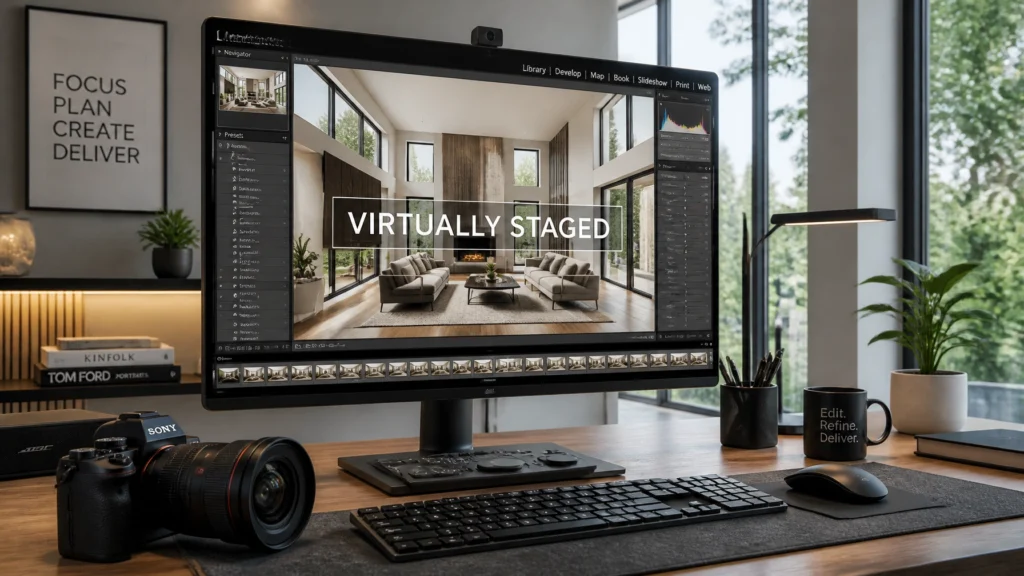
The Rule: The image must carry a visible watermark or label that says “Virtually Staged.”
Pro Tip: Don’t hide this in 4pt font in the corner. Make it legible. At RE Media Systems, we teach students to include the staged photo immediately after the photo of the empty room in the delivery gallery.

2. Sky Replacements & Virtual Twilight
In 2026, many MLSs have started flagging “impossible sunsets.” If you use AI to create a dramatic twilight shot from a photo taken at 2 PM, it must be labeled as “Digitally Enhanced” or “Virtual Twilight.”
3. Object Removal (The Danger Zone)
This is where photographers get into the most trouble. Removing a “For Sale” sign or a trash can is generally considered “de minimis” (too small to matter). However, removing permanent fixtures, like a telephone pole in the backyard or a fire hydrant in the front, is a major no-no.
If you must remove a permanent object for “artistic purposes,” you must disclose it in the listing remarks.
4. Generative AI “Fixes”
Using AI to “finish” a renovation (adding flooring that hasn’t been laid yet) is now strictly regulated. If the flooring doesn’t exist, the photo is a “Rendering,” not a “Photograph.” Treat it as such.
Proper Disclosure Templates: What to Give Your Agents
Agents are terrified of the “Legal” section of their listing. You can win their loyalty for life by providing the exact text they need to copy and paste into their MLS remarks.
I include a “Compliance PDF” with every delivery that includes these templates:
- For Virtual Staging: “Some photos in this listing have been virtually staged to illustrate the property’s potential. Original unedited photos are available upon request or visible in the photo gallery.”
- For Virtual Twilight/Sky Swaps: “Exterior images have been digitally enhanced to reflect twilight conditions. Physical features of the property have not been altered.”
- For General AI Enhancements: “This listing utilizes AI-enhanced photography for clarity and lighting. No permanent structural features were added or removed.”
How to Frame Disclosure as a Value-Add
Most photographers see disclosure as a “hassle” or a “speed bump.” I want you to change your mindset. This is a selling point.
When you’re pitching a new agent, don’t just talk about your 4K drone video or your fast turnaround. Say this:
“I know the 2026 AI laws are a headache for brokers right now. My system automatically handles all the compliance for you. I provide labeled images, keep a vault of your original RAW files for legal protection, and give you the exact disclosure language for your MLS. I handle the compliance so you can focus on the sale.”
That shift in positioning turns you from a vendor into a consultant. You’re solving a legal problem, and that is worth a premium price.
Common Disclosure Mistakes to Avoid
- The “Hidden” Watermark: Placing “Virtually Staged” in a color that blends into the floor. If a judge can’t see it, it doesn’t count.
- Forgetting the Metadata: Modern AI tools like Adobe Firefly embed “Content Credentials” in the metadata. If you try to strip this out to hide the AI usage, you are showing “intent to deceive,” which makes legal penalties much worse.
- Relying on the Agent: Never assume the agent knows the rules. If you deliver a virtually staged photo without a label, and the agent posts it, they will blame you when they get fined. Always deliver labeled versions by default.
Transparency Builds Trust (The Scott Prokop Philosophy)
Over 10,000 homes, I’ve learned one universal truth: Trust is the only currency that matters in real estate.
Buyers are smarter than they used to be. They can spot an AI-generated sky from a mile away. When you’re transparent about your edits, you aren’t “admitting to a fake”, you’re demonstrating professionalism.
When a buyer sees “Virtually Staged” on a beautiful photo, they don’t think, “This is a lie.” They think, “Wow, this agent is professional and helpful.”
By following these systems, you ensure your business remains “audit-proof” while still reaping the efficiency rewards of AI.
The 2026 AI Disclosure Checklist
To make this easy, here is the checklist I use for every shoot in my business:
- Identify Material Changes: Did I add or remove anything that is physically part of the property?
- Apply Visual Labels: Are my virtually staged or enhanced images clearly watermarked?
- Export Originals: Have I provided a “clean” version of every altered shot?
- Metadata Check: Are the Content Credentials intact for Generative AI fills?
- Agent Copy: Have I included the disclosure templates in my delivery email?
Final Recommendation
The rules are changing, but the goal remains the same: Shoot faster, earn more, and build a better business. AI is the tool that helps you do the first two; compliance is the tool that ensures the third one lasts.
If you want to see the specific tools I use to handle these edits efficiently, keep an eye out for our Best AI Tools for Real Estate Photographers guide (coming soon!).
Ready to upgrade your workflow?
Explore my Recommended Gear or join our newsletter for weekly tips on scaling your real estate media business without the burn-out.