
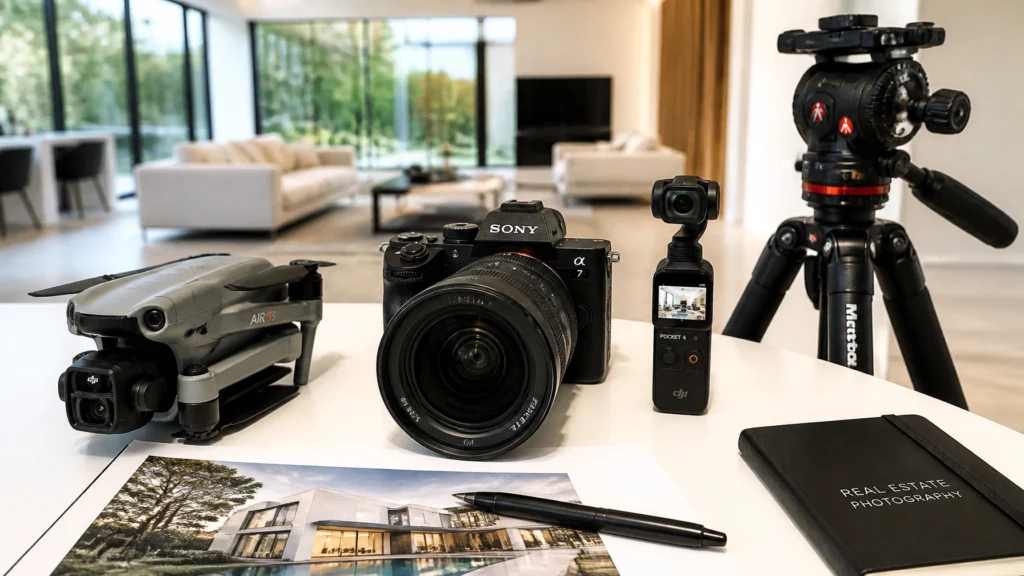
After 14 years in the trenches and over 10,000 homes photographed, I’ve learned one expensive lesson: The best gear isn’t the gear with the most megapixels, it’s the gear that helps you get home for dinner.
In the real estate media business, your gear is an investment in your hourly rate. If a new camera saves you 10 minutes per shoot, and you do 500 shoots a year, that’s over 80 hours of your life back. That is why I don’t care about “spec sheets” nearly as much as I care about “workflow speed.”
In this guide, I’m breaking down the exact kit I recommend for 2026. Whether you are just starting out or you’re looking to scale a multi-photographer team, this is the equipment that produces pro results while keeping your business lean and fast.
Quick Verdict: Does Gear Matter?
Gear doesn’t make the photographer, but it certainly makes the photographer faster.
If you are looking for the “Too Long; Didn’t Read” version: The Sony A7 V (or A7 IV) paired with the Sony 16-35mm f/2.8 GM II is the undisputed king of the industry right now. Combine that with a DJI Air 3S for aerials and AutoHDR for your editing, and you have a business-in-a-box that can handle 95% of every home on the market.
Why I Recommend This Setup
I’ve used almost every brand under the sun, Canon, Nikon, Fujifilm, and even medium format for luxury architecture. But for high-volume real estate (the “bread and butter” of our industry), I’ve standardized my entire company on Sony and DJI.
Why? Reliability and Ecosystem.
When you’re shooting 5–7 homes a day, you can’t afford a camera that overheats or a drone that takes ten minutes to calibrate. You need a system that “talks” to each other, uses the same batteries where possible, and has a predictable file output that your editors (or AI tools) can chew through quickly.
My “60-minute shoot” philosophy depends on having gear that gets out of the way. If I’m fighting my tripod or waiting for a slow buffer, I’m losing money.
The Camera Body: Sony A7 V vs. A7 IV
The “best camera for real estate photography” in 2026 comes down to these two full-frame powerhouses.
Sony A7 V: The New Standard
The Sony A7 V is currently the pinnacle of real estate media. The biggest reason I recommend it isn’t the resolution, it’s the In-Body Image Stabilization (IBIS) and the AI-driven autofocus.
For years, we were tethered to tripods for every single shot. But with the A7 V, the stabilization is so good that I can shoot handheld HDR brackets in well-lit rooms. This is a massive game-changer for speed.
- Key RE Feature: Enhanced bracketing options that allow you to fire off 5 exposures in a fraction of a second.
- Workflow Advantage: Faster transitions between rooms. No more “leg-work” with the tripod in tight powder rooms.
Sony A7 IV: The Value King
If the A7 V is out of budget, the Sony A7 IV is still an absolute workhorse. I still have three of these in my fleet. It handles 33MP (perfect for print and web), has great dynamic range, and a flip-out screen that makes getting those low-angle kitchen shots much easier on your back.
Scott’s Field Note: Don’t buy a $3,000 camera and put a $400 lens on it. The lens is where the quality happens. If you’re on a budget, buy a used Sony A7 III and invest the savings into a high-end wide-angle lens.

Lenses: The Wide-Angle Workhorse
If the camera is the brain, the lens is the eye. In real estate, 90% of your photos will be shot between 16mm and 24mm.
The Gold Standard: Sony 16-35mm f/2.8 GM II
The Sony 16-35mm f/2.8 GM II is, quite simply, the best lens I’ve ever used for this job. It is incredibly sharp from corner to corner, which is vital when you’re trying to show off a luxury kitchen or a spacious master suite.
- Why f/2.8? While we usually shoot at f/8 for depth of field, that f/2.8 aperture makes the autofocus “snappier” in dark basements because it lets in more light for the sensor to see.
The Budget Alternative: Tamron 17-28mm f/2.8
If you’re looking to save $1,000, the Tamron 17-28mm f/2.8 is a fantastic lens. It’s lightweight, sharp, and fits perfectly on Sony bodies. The only downside is you lose that extra 1mm on the wide end (which matters in small bathrooms) and the reach on the 35mm end for detail shots.
Related Guide: [The $2,500 Lens Mistake You Need to Avoid! (YouTube)]
Drones: The New Standard (DJI Air 3S)
Drone photography is no longer an “add-on”, it’s expected. If you aren’t offering aerials, you’re leaving $50–$150 on the table for every shoot.
The Primary Choice: DJI Air 3S
The DJI Air 3S is my daily driver. It has a dual-camera system (wide and medium telephoto) which allows me to get both the “whole property” shot and a “compressed neighborhood” shot without changing drones or lenses.
- Stability: It handles wind like a champ.
- Safety: The obstacle avoidance in 2026 is so good it’s almost impossible to crash (almost!).
The “Tight Neighborhood” Choice: DJI Mini 5 Pro
In dense urban areas or when I’m traveling light, the DJI Mini 5 Pro is incredible. Because it’s under 250g, the regulations are much more relaxed in many regions.
Deep Dive: The Complete Guide to Drone Photography for Real Estate
Video Gear: Cinematic Walkthroughs
Social media has shifted the demand from “nice-to-have” video to “essential” vertical reels.
The “Cheat Code”: DJI Osmo Pocket 4
The DJI Osmo Pocket 4 is the best investment a real estate photographer can make for video. It’s a 3-axis stabilized 4K camera that fits in your pocket.
- Why I love it: I can finish my photos, pull this out, and walk through the house in 10 minutes. The footage is buttery smooth, and the “Creator Combo” comes with a wireless mic for when agents want to do a “talking head” intro.
The Pro Setup: DJI RS 5 + Sony A7 V
For high-end luxury films, I use the DJI RS 5 Gimbal. It’s more work to set up, but it allows you to use your high-end GM lenses for that shallow depth-of-field look that clients pay a premium for.
Lighting: When You Actually Need It
I am a huge advocate of the Complete HDR Real Estate Photography Guide workflow because it’s fast. However, sometimes you need to “pop” a dark room or fix a weird color cast from a bright green lawn outside.
The Godox System
I recommend the Godox V1 Round-Head Flash. It has a magnetic mount for modifiers and a lithium battery that lasts for 10+ shoots. Pair it with the Godox XPro Wireless Trigger so you can “light paint” or hide flashes in other rooms.
Accessories: The Unsung Heroes
Most photographers spend all their money on the camera and then buy a cheap tripod. Don’t do this.
The Geared Head: Manfrotto 410 Junior
If you are still using a ball head for real estate, you are wasting time. The Manfrotto 410 Junior Geared Head allows you to make tiny, precise adjustments to your tilt and level.
- Pro Tip: Keep your verticals straight. A geared head makes this effortless.
The Tripod: Manfrotto 055 Aluminum
The Manfrotto 055 is the industry standard for a reason. It’s heavy enough to be stable but light enough to carry all day.
Related Guide: [Stop Letting Your Tripod Eat Your Hourly Rate! (YouTube)]
Software & AI Stack: The Modern Workflow
In 2026, your “gear” includes your software. If you’re still manually blending HDRs in Photoshop for hours, you aren’t running a business; you’ve bought yourself a low-paying job.
- AutoHDR: This is my secret weapon. I upload my raw brackets, and it returns perfectly blended, natural-looking HDR images in minutes.
- Fotello: For virtual staging. It’s fast, looks realistic, and allows me to offer an upsell that takes me 5 minutes but earns me $30+ per photo.
- HDPhotoHub: This is the backbone of my business. It handles my bookings, payments, and photo delivery. I don’t send a link until the client has paid. This one tool solved 90% of my “business stress.”

Who Should Buy This Kit?
The Solo Pro (The “Optimizer”)
You’ve been shooting for a while and want to maximize profit.
- Kit: Sony A7 V + 16-35mm GM II + DJI Air 3S + Osmo Pocket 4.
- Goal: Shoot a house in 45-60 mins, deliver next morning via HDPhotoHub.
The Newbie (The “Value Starter”)
You’re building your portfolio and need a kit that won’t break the bank.
- Kit: Sony A7 IV (or used A7 III) + Tamron 17-28mm + DJI Mini 5 Pro.
- Goal: Professional results with a lower barrier to entry.
The Scaling Team (The “System Builder”)
You’re hiring other photographers and need consistency.
- Kit: Standardized Sony A7 IV units across the board.
- Goal: Identical file types so your one editor can process everything predictably.
FAQ: Real Estate Photography Gear
1. Can I use a cropped sensor (APS-C) camera?
Yes, but I don’t recommend it if you want to be a “pro.” Full-frame sensors handle high-contrast scenes (bright windows, dark corners) much better.
2. Why Sony over Canon?
Canon is great, but Sony’s third-party lens support (Tamron/Sigma) is much better, which saves you thousands of dollars when building a team.
3. Do I really need a drone?
In 2026? Yes. Even if the house is ugly, agents want a “map” view of the neighborhood.
4. What is the best focal length?
16mm is the “sweet spot.” Anything wider than 14mm starts to look like a funhouse mirror.
5. Handheld vs. Tripod?
I shoot 80% on a tripod for precision, but the A7 V’s stabilization allows for handheld “speed runs” in simpler homes.
6. Mac or PC for editing?
MacBook Pro with M3/M4 chips. The battery life and screen accuracy are unbeatable for editing on the go.
7. How many batteries do I need?
Three for the camera, three for the drone. You never want to be the guy asking a homeowner to plug in a charger.
8. Is virtual staging worth it?
Yes. It’s the highest ROI service we offer. Use Virtual Staging AI for quick turnarounds.
9. Do I need a 360 camera?
Yes, for Matterport or Zillow 3D. The Ricoh Theta Z1 is still the gold standard for image quality in 360.
10. How do I deliver files?
Never use Dropbox or Google Drive for professional delivery. Use HDPhotoHub so you can get paid before they download.
11. What SD cards should I buy?
V60 or V90 cards. Don’t go cheap here; a corrupted card is a nightmare.
12. Do I need a geared head?
If you want to be fast and accurate, yes. It will change your life.
13. Should I buy a Matterport Pro3?
Only if you are doing massive commercial spaces. For residential, the Insta360 X4 or Ricoh is plenty.
14. How much should I spend on my first kit?
Expect to invest $5,000–$7,000 for a “proper” pro setup that will last 5 years.
15. What’s the best way to learn the gear?
Read our Real Estate Photography Pricing Guide (2026) to make sure you’re charging enough to pay for it!
Final Recommendation
Gear is a tool, not a trophy. My goal at RE Media Systems is to help you build a business that serves your life, not a hobby that eats your time.
If you’re starting today, grab a Sony A7 IV, the Sony 16-35mm GM II, and a DJI Air 3S. That kit alone has been responsible for millions of dollars in photography fees for my students and my own business.