
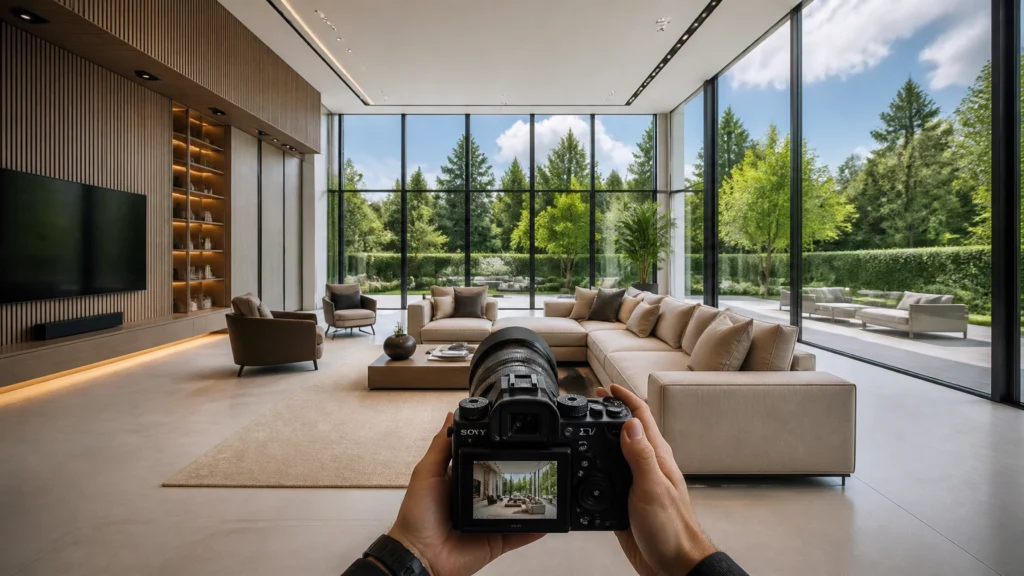
If you’ve been following my journey at RE Media Systems for any length of time, you know I’m obsessed with efficiency. After photographing over 10,000 homes and spending 14+ years in this industry, I’ve learned that your gear should never be a bottleneck, it should be an accelerator.
For the last year, the Sony A7 V has been my primary daily driver. I’ve put it through the wringer in everything from $200,000 starter homes with zero natural light to $10M luxury estates with floor-to-ceiling windows.
The question everyone keeps asking me is: “Scott, is this really the best camera for real estate photography, or is it just another marginal upgrade?”
I recently posted a YouTube video titled “Is This the Best Handheld HDR Camera Ever Made?” where I touched on some of these points. But today, I want to go deep. This isn’t a “spec sheet” review you’ll find on a tech blog. This is a boots-on-the-ground evaluation of how this camera actually performs inside a house when you have three more shoots scheduled and the sun is going down.
Quick Verdict
Who should buy it?
If you are a professional real estate photographer looking to move to a handheld HDR workflow, the Sony A7 V is currently the gold standard. Its improved In-Body Image Stabilization (IBIS), AI-driven exposure bracketing, and fast buffer make it the most efficient tool for shooting interiors without a tripod. It’s also the perfect “one-body solution” if you provide high-end video walkthroughs alongside stills.
Who should skip it?
If you exclusively shoot on a tripod and already own a Sony A7 IV or A7R V, the image quality improvements alone might not justify the upgrade cost. Similarly, if you are a beginner on a tight budget, the A7 IV remains a more cost-effective entry point into the Sony ecosystem.
Overall Recommendation
The Sony A7 V is a powerhouse. It doesn’t just take photos; it enables a faster way of doing business. It’s the first camera that truly feels like it was designed with the speed and dynamic range requirements of real estate media in mind.
Why I Switched to the Sony A7 V
When the Sony A7 V was released, I wasn’t looking for more megapixels. I was looking for more reliability and speed.
I moved from the A7 IV to the A7 V for three primary reasons:
- The Handheld Revolution: My entire business model shifted when I ditched the tripod. To do that successfully, you need a camera that can handle 5-shot brackets at 1/15th of a second without blur. The A7 V’s upgraded stabilization (rated at 8 stops) was the final piece of the puzzle.
- AI-Enhanced Processing: The new AI chip handles White Balance and Exposure better than any body I’ve ever used. When shooting a kitchen with mixed tungsten, LED, and natural daylight, the A7 V nails the color temperature significantly more often than the A7 IV. This means less time in Lightroom fixing “orange” ceilings.
- Video Capabilities: We are doing more video than ever. The ability to shoot 4K 60p without a heavy crop and utilize the “Active Stabilization” means I can often leave the gimbal in the car for quick social media reels.
After 10,000 homes, I’ve realized that 5 minutes saved per house equals dozens of hours back in my life every month. The A7 V saves me those minutes.
What Matters for Real Estate Photography
In the world of architectural photography, we don’t care about “eye-tracking for birds” or “20 frames per second sports bursts.” We care about dynamic range and consistency.
Dynamic Range
The A7 V features a 33MP sensor that holds roughly 15 stops of dynamic range. In real estate, this is the difference between a “white blob” window and a crisp view of the backyard. Even in a single exposure, the shadows are remarkably clean.
HDR Bracketing
This is the heart of my workflow. The A7 V allows for high-speed continuous bracketing. You can fire off 3, 5, or 7 frames in a fraction of a second. Because the sensor readout is so fast, there is almost no movement between the frames, making the HDR merge in Lightroom perfectly sharp every time.
Handheld Shooting
The IBIS in the A7 V is a noticeable step up from its predecessor. When paired with a stabilized lens like the Sony 16-35mm f/4 G PZ, I can comfortably shoot down to 1/10th of a second handheld. This allows me to keep my ISO lower (around 400-800) even in dark rooms, resulting in cleaner files.
Low-Light Interiors
Basements and windowless bathrooms are the bane of our existence. The A7 V handles high ISO (up to 3200-6400) with very little chroma noise. When you’re shooting handheld HDR, you sometimes have to bump the ISO to keep your shutter speed up; the A7 V’s sensor is incredibly forgiving here.
Video Performance
Real estate listings now require video. The A7 V offers 10-bit 4:2:2 internal recording. This gives you the “meat” in the file to grade your footage so that the windows don’t blow out and the interior colors look lush and expensive.
Real-World Performance: The “Home Test”

How does it actually feel on the job?
The Bright Window Challenge
I recently shot a modern condo with floor-to-ceiling south-facing windows at noon. This is a nightmare scenario. With the A7 V, I set my bracket to 5 shots at 2.0 EV steps. The fastest shutter hit 1/4000th to catch the clouds outside, while the slowest pulled detail from the dark navy sofa inside. The result? A perfectly balanced image that took me 2 seconds to capture.
The Dark Basement Test
In a finished basement with only a few pot lights, the A7 V’s autofocus didn’t hunt. It locked on the corner of the room instantly. Using the fully articulating screen, I held the camera high in a corner to get the “wide” perspective, and the stabilization kept the shot tack-sharp despite the low light.
The Speed Shoot
On a day with six “Standard” shoots, I was in and out of each 2,000 sq. ft. home in under 25 minutes. No tripod legs to adjust, no leveling head to fiddle with. I just walked the rooms, fired the brackets, and moved on. The A7 V’s buffer never choked once.
Workflow Improvements: Earn More by Shooting Faster
The RE Media Systems philosophy is: Shoot Faster, Earn More.
The Sony A7 V improves your business’s bottom line in several ways:
- Consistency: Because the AI processing is more accurate, your “Before” files are more consistent. This makes it easier to use AI Editing tools or outsource your editing.
- Culling Speed: With “Blackout-Free” shooting, you can see exactly what you’re getting. You spend less time checking if a shot was “sharp enough” on the back of the screen.
- Delivery Speed: Cleaner HDR files merge faster in software. If you do your own editing, you’ll notice Lightroom spends less time “thinking” about these 33MP files compared to the massive 61MP files from the A7R series.
- Client Perception: Walking through a home with a sleek, handheld setup looks professional and high-tech. It shows the client you are efficient and respect their time.
Pros and Cons
Pros
- Best-in-class IBIS: Makes the “Handheld HDR Revolution” possible for almost anyone.
- 33MP Resolution: The “Sweet Spot”, plenty of detail for large prints/crops without the massive file size of the R-series.
- AI Processing Unit: Better White Balance and faster, more accurate AF in dim rooms.
- Ergonomics: The grip is deep and comfortable for all-day shoots.
- Fully Articulating Screen: Essential for getting the camera into tight corners or shooting high/low angles.
Cons
- Price Point: It’s a professional investment, and the body-only price can be steep for those just starting out.
- Menu Complexity: Sony’s menus are better than they used to be, but they still have a steep learning curve for beginners.
- Battery Life: While good, shooting 4K video and high-speed brackets all day means you will need a second or third battery.
Who Should Buy It?
- The High-Volume Pro: If you’re shooting 15+ homes a week, the time savings alone will pay for this camera in two months.
- The Hybrid Shooter: If you offer both photos and high-end walkthrough videos, this is the most balanced body on the market.
- The Handheld Convert: If you want to stop carrying a tripod into every room, this is your camera.
Who Should Skip It?
- The “Tripod Only” Purist: If you never shoot handheld and never shoot video, an older Sony A7R III or A7 IV will give you similar results for less money.
- The “Stills Only” Beginner: If you are just starting your business, put that extra $1,500 into a high-end wide-angle lens.
Recommended Lenses for the A7 V
Your camera is only as good as the glass you put in front of it. Here is what I recommend for the A7 V:
- Sony 16-35mm f/4 G PZ: My #1 choice. It’s incredibly light, sharp, and the Power Zoom is great for video.
- Sony 12-24mm f/4 G: For those tiny bathrooms and tight laundry rooms where 16mm isn’t quite wide enough.
- Sony 24-70mm f/2.8 GM II: Great for “detail” shots, close-ups of luxury finishes, or agent headshots.
Recommended Accessories
Don’t let a $10 SD card ruin a $2,000 camera.
- Memory Cards: Use V60 or V90 SDXC cards. The A7 V writes a lot of data quickly during brackets; slow cards will cause the camera to “lock up” while it saves.
- Batteries: Always carry at least two spare NP-FZ100 batteries.
- Tripod: Even though we shoot handheld, I still keep a Peak Design Carbon Fiber Tripod in the car for low-light “Twilight” exteriors.
- Cleaning Kit: Dust on the sensor is your worst enemy. Keep a rocket blower and sensor swabs in your bag.

Frequently Asked Questions
1. Can I really shoot real estate handheld with the A7 V?
Yes. I do it every day. With the improved IBIS and fast bracketing, you can get tack-sharp images at shutter speeds that used to require a tripod.
2. Does it overheat during video?
I haven’t experienced any overheating issues during standard 2-3 minute property walkthroughs, even in 4K 60p.
3. Is 33MP enough for high-end listings?
More than enough. Most MLS systems downsize images anyway. 33MP gives you plenty of room to crop if you need to straighten a shot or zoom in on a feature.
4. How does the A7 V compare to the A7 IV?
The main differences are the AI processing chip, better IBIS, and improved video specs. If you are a handheld shooter, the upgrade is significant.
5. Which wide-angle lens is best for this camera?
The Sony 16-35mm f/4 G PZ is the most versatile and lightweight option for real estate media.
6. Can it shoot 4K 120p?
Yes, but with a significant crop. For real estate, 4K 60p is usually more than enough for slow-motion walkthroughs.
7. Does it have dual card slots?
Yes, it has two slots that support both SD (UHS-II) and CFexpress Type A cards.
8. Is the autofocus fast enough for video?
It’s arguably the best on the market. The AI subject recognition stays locked on the room even as you move through doorways.
9. Can I use my old Sony batteries?
If you are coming from an A7 III or IV, yes. It uses the same NP-FZ100 batteries.
10. Do I need CFexpress cards?
For photos, no. High-speed V60 or V90 SD cards are fine. For the highest bitrate video, CFexpress is recommended but not strictly required for most RE work.
Final Recommendation
The Sony A7 V isn’t just a camera; it’s a business tool.
If your goal is to build a modern real estate media business that is fast, profitable, and delivers high-quality results without the physical toll of traditional “slow” photography methods, this is the body to buy. It supports the Handheld HDR workflow better than any other camera I’ve tested in 14 years.
It’s reliable, it’s fast, and it produces beautiful files that your clients will love.
Pingback: The Complete HDR Real Estate Photography Guide: Shoot Faster & Earn More