
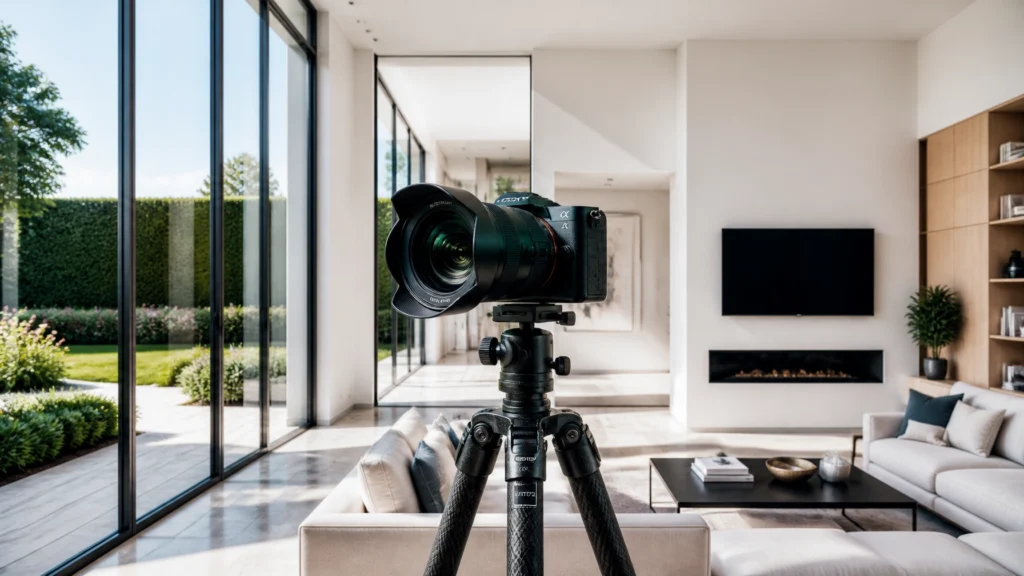
For over 14 years and more than 10,000 homes photographed, I’ve heard the same debate: “You need a full-frame camera if you want to be taken seriously in real estate.”
In the early days, that was mostly true. APS-C sensors struggled with noise in dark hallways, and the dynamic range was often too narrow to handle the “blown-out window” problem we face every single day. But it’s 2026, and the technology has shifted. The Sony a6700 is the latest evolution of Sony’s crop-sensor lineup, and honestly, it’s making a lot of photographers question why they are carrying around heavy, expensive full-frame rigs.
If you’re looking to shoot faster, earn more, and build a business without overspending on gear that doesn’t actually move the needle for your clients, this guide is for you. We’re going to dive deep into whether the Sony a6700 is a “budget compromise” or a strategic business tool for the modern real estate media professional.
1. Quick Verdict
Is it recommended? Yes, absolutely.
Who is it for? High-volume real estate photographers, hybrid shooters who do a lot of video, and those looking for a lightweight, high-performance backup or primary body.
Worth buying today? 100%. In 2026, the a6700 offers the best price-to-performance ratio in the Sony ecosystem for real estate media.
2. Why I Recommend This Camera
I’ve spent the better part of a decade shooting with everything from the original Sony A7 to the A7R series and the A7 IV. When the a6700 landed, I was skeptical. I’ve always been a full-frame guy because I need every bit of dynamic range I can get when I’m trying to pull a view out of a window in a dark basement.
However, the a6700 solved a specific problem in my workflow: Efficiency.
In a business where your profit is tied to how many homes you can shoot in a day and how fast you can get them edited, the a6700 is a powerhouse. It’s small, the autofocus is lightyears ahead of older models, and the files are surprisingly robust. For 95% of the listings you’ll shoot, from $300k condos to $2M family homes, your clients will never be able to tell the difference between an a6700 file and an A7 IV file once they are processed through an HDR workflow.
I started using the a6700 for high-volume days where I had 5+ shoots scheduled. The lighter weight meant less fatigue, and the incredibly fast startup time and AI-driven autofocus meant I was shaving minutes off every room.
3. Key Features That Matter (Real Estate Specific)
When you’re reading a spec sheet, it’s easy to get distracted by “megapixels” and “burst rates.” For real estate, most of those don’t matter. Here is what actually impacts your bottom line with the a6700:
Advanced AI Processing Unit
The a6700 inherits the AI chip from the much more expensive A7R V. While we don’t care about “bird-eye tracking,” this chip makes the camera incredibly snappy. It recognizes scenes and subjects instantly, ensuring that even when you’re shooting handheld in a pinch, your focus is locked exactly where it needs to be.
26.0 MP BSI CMOS Sensor
26 megapixels is the “sweet spot” for real estate. It’s enough resolution to allow for aggressive cropping if you didn’t quite get the composition right, but the file sizes aren’t so massive that they bog down your editing workflow or fill up your hard drives.
4K 120p and 10-Bit Video
This is where the a6700 punches way above its weight class. Many real estate agents now demand “Cinematic Reels.” Being able to shoot 4K at 120fps in 10-bit 4:2:2 means you can deliver butter-smooth slow-motion walk-throughs that look professional. The A7 IV, for comparison, has a heavy crop in 4K60 and can’t even touch 120p.
Bracketing Performance
Like its big brothers, the a6700 handles exposure bracketing beautifully. It allows for ±3.0 EV steps, meaning you can capture the full dynamic range of a room in just 3 to 5 shots. This is essential for our HDR systems.

4. Real-World Performance: In the Trenches
Let’s talk about the two biggest challenges we face: Windows and Dark Corners.
The “Window” Test
In real estate photography, we live and die by our ability to see what’s outside the window while keeping the interior looking natural. The a6700’s Back-Illuminated (BSI) sensor provides roughly 14 stops of dynamic range. In my testing, when I shoot a 5-shot bracket, I have more than enough data to blend a clean window view.
Is it as “clean” as the A7 IV? If you zoom in to 400% in the shadows, you might see a tiny bit more noise in the a6700 files. But here’s the secret: No one looks at listing photos at 400%. On a Zillow listing or a printed flyer, the difference is invisible.
Handheld HDR
One of the systems we teach at RE Media Systems is how to shoot faster. Sometimes, you don’t have time to set up a tripod in a tight powder room. The a6700’s In-Body Image Stabilization (IBIS) combined with its fast burst rate makes handheld bracketing viable in well-lit rooms. This is a massive time-saver.
5. Workflow Advantages: Speed and Consistency
The real reason to choose the a6700 isn’t just the price, it’s the system.
- Lens Selection: APS-C wide-angle lenses are smaller, lighter, and often cheaper. The Sony 10-20mm f/4 PZ is a masterpiece for real estate. It’s tiny, sharp, and makes gimbal work a breeze because the weight doesn’t shift when you zoom.
- Battery Life: The a6700 uses the NP-FZ100 battery (the same as the A7 IV). This is huge. I can usually get through 3-4 full house shoots on a single battery.
- Menu System: It features the new Sony touch-responsive menus. If you’re coming from an older a6400 or a6000, this will change your life. It’s intuitive and allows you to save custom “Real Estate” profiles that you can toggle in a second.
6. Pros: Why You’ll Love It
- Price: You can often find the body for $1,000 less than an A7 IV. That’s $1,000 you can put toward a DJI drone or a high-end tripod.
- Video Capabilities: It is a superior video camera to almost anything in its price range. If you offer video tours, this is your best friend.
- Portability: It fits into smaller bags and stays balanced on smaller, cheaper gimbals like the DJI RS 3 Mini.
- Autofocus: Faster and more “intelligent” than many full-frame cameras from 2-3 years ago.
7. Cons: Honest Limitations
- Single Card Slot: This is the biggest “pro” vs “amateur” divider. If your SD card fails, you lose the shoot. I’ve personally only had one card fail in 14 years, but for some, the lack of a backup slot is a deal-breaker.
- Rolling Shutter: If you’re whipping the camera around quickly in video mode, you’ll see some “jello” effect. You have to move smoothly.
- Crop Factor: A 10mm lens on this camera is equivalent to 15mm on full-frame. You have to be careful with your lens choices to ensure you stay wide enough for small bathrooms.
8. Who Should Buy This Camera?
- The New Pro: If you’re just starting and want a professional setup without spending $5,000.
- The High-Volume Shooter: If you shoot 10+ homes a week and want to minimize gear weight.
- The Hybrid Specialist: If 50% of your revenue comes from video/reels, the a6700 is actually a better choice than many full-frame alternatives.
9. Who Should Skip It?
- Luxury & Architecture Specialists: If you are shooting for high-end designers or architects who want 50-megapixel prints and perfect shadow recovery, stick with the Sony A7R V or A7 IV.
- The “Dual-Slot” Crowd: If your business insurance or your own peace of mind requires redundant recording, the a6700 won’t cut it.
10. Recommended Accessories
To make the a6700 a true real estate workhorse, I recommend these additions:
- Lens: Sony E 10-20mm f/4 PZ G. It is wide, sharp, and ultra-light.
- Tripod: A solid carbon fiber tripod like the ones found on our Recommended Gear page.
- SD Card: Sony Tough-series cards (since you only have one slot, make it a reliable one).
- Gimbal: DJI RS 3 Mini. Perfect weight match for this camera.

11. Alternatives: Sony a6700 vs. The Field
| Feature | Sony a6700 | Sony A7 IV | Sony a6400 |
|---|---|---|---|
| Sensor | APS-C (26MP) | Full-Frame (33MP) | APS-C (24MP) |
| Card Slots | 1 | 2 | 1 |
| Video | 4K 120p (10-bit) | 4K 60p (10-bit) | 4K 30p (8-bit) |
| IBIS | Yes | Yes | No |
| Price | ~$1,398 | ~$2,498 | ~$899 |
The A7 IV is the “gold standard” for a reason, it has the dual slots and slightly better low-light performance. But for $1,100 less, the a6700 gives you 90% of the photo quality and better video features.
12. FAQ: 10 Practical Buying Questions
1. Is 26MP enough for large prints?
Yes. You can easily print a 24×36 inch poster from a 26MP file. Most real estate marketing is digital or small-format print (brochures), where 26MP is overkill.
2. Does the a6700 overheat during video tours?
In my experience, no. For 2-3 minute walk-throughs, it’s fine. If you were filming a 2-hour wedding in 4K, it might be an issue, but for real estate, it’s a non-factor.
3. What is the best lens for the a6700 for real estate?
The Sony 10-20mm f/4 PZ G. If you want something cheaper, the older Sony 10-18mm f/4 is still a solid performer on the used market.
4. Can I use my full-frame lenses on the a6700?
Yes, but they will be “zoomed in” by 1.5x. A 16-35mm full-frame lens becomes a 24-52mm lens, which isn’t wide enough for most interiors.
5. How is the battery life compared to the a6400?
Massively improved. The a6700 uses the larger Z-series battery, lasting about twice as long as the older W-series batteries in the a6400.
6. Is the screen good for high/low angles?
Yes, it has a fully articulating “flip-out” screen, which is much better for vertical shots or shooting over your head than the old tilt-style screens.
7. Does it have a built-in flash?
No. But for our HDR and Flambient workflows, you’ll want a dedicated external trigger and flash anyway.
8. Can I shoot 360 virtual tours with this?
You can shoot the “panoramas” manually, but for efficiency, we recommend dedicated tools like those on our Virtual Tour Gear Guide.
9. Is the single card slot really that risky?
In 10,000 homes, I’ve had one failure. Use high-quality cards and format them in-camera every time, and you’ll likely be fine. But it’s a risk you have to weigh.
10. Should I upgrade from an a6400?
Yes. The addition of IBIS, the better battery, the 10-bit video, and the vastly superior menu system make it a worthy upgrade for a professional.
13. Final Recommendation: Is it “Good Enough” in 2026?
The Sony a6700 isn’t just “good enough”: it’s a smart business move.
If you are a solo operator looking to maximize your profit margins, there is no reason to spend $2,500+ on a full-frame body when the a6700 delivers professional-grade files that will make your clients happy. Its video features actually put it ahead of many “pro” cameras for the TikTok/Reels era of real estate marketing.
Invest the money you save into better lighting, a better drone, or marketing systems to find more clients. That is how you build a better real estate media business.
Ready to level up your gear?
- Check out our Full Recommended Gear List
- Subscribe to our newsletter for more “no-fluff” business tips.