
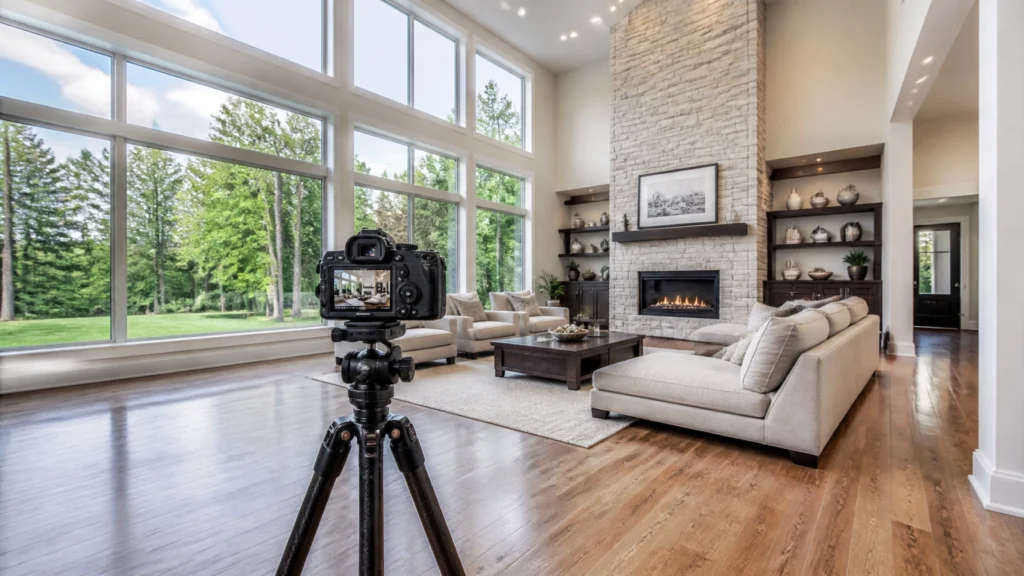
When you are starting your journey in real estate photography, the “Full Frame vs. APS-C” debate is probably the first wall you hit. You see high-end pros carrying $4,000 rigs and you wonder: Can I actually compete with a crop-sensor camera?
After 14 years in the industry and over 10,000 homes photographed, I can tell you the answer is a resounding yes. In fact, for a lot of photographers just getting their feet wet, a camera like the Canon EOS R10 isn’t just “enough”, it’s actually a smarter business move.
The Canon EOS R10 for real estate photography represents the “sweet spot” of the modern mirrorless era. It’s light, it’s fast, and it’s significantly more affordable than its full-frame siblings. But as with any budget-friendly tool, there are trade-offs you need to understand before you swipe your card.
In this guide, I’m going to break down exactly how the R10 performs in the field, why I recommend it for newcomers, and how to set it up so you can shoot faster and earn more from day one.
1. Quick Verdict
Is it recommended? Yes, absolutely.
Who is it for? Beginners, hobbyists looking to go pro, and established photographers needing a lightweight backup or a secondary body for video/floor plans.
Worth buying today? 100%. With the release of the RF-S 10-18mm lens, the R10 has become one of the most cost-effective ways to enter the Canon mirrorless ecosystem.
The Canon R10 is the ultimate “get in the door” camera. It provides professional-level image quality (24.2MP) and the essential features needed for high-end HDR photography without the “full-frame tax.”
2. Why I Recommend This Camera
My philosophy at RE Media Systems is simple: Buy the gear that helps you build a better business.
Early in my career, I shot with Canon Rebels and crop-sensor bodies for years. Clients didn’t care about my sensor size; they cared that the windows weren’t blown out and the vertical lines were straight. The R10 is the modern evolution of those workhorse cameras.
I recommend the R10 because it solves the biggest problem for new photographers: Startup Costs. By saving $1,000+ on the camera body compared to an R6 Mark II or even an R8, you can invest that money into a high-quality tripod, a solid wide-angle lens, and marketing to get your first 10 clients.
In my workflow, efficiency is king. The R10 is small enough that I can carry it all day without fatigue, and its autofocus system is actually better than many full-frame cameras from just a few years ago.
3. Key Features That Matter for Real Estate
In our niche, we don’t care about 30 frames per second or extreme weather sealing as much as we care about three specific things: Resolution, Bracketing, and Lens Selection.
24.2MP APS-C Sensor
Don’t let the “Crop” label scare you. 24.2 megapixels is the gold standard for real estate. Most of your photos will end up on the MLS at 2000px wide. Having 24MP gives you more than enough detail to crop in if you need to fix a composition in post without losing quality.
Auto Exposure Bracketing (AEB)
This is the heartbeat of real estate photography. To get those “crispy” HDR shots where you see the interior and the view out the window, you need to bracket. The R10 allows for 3-shot bracketing up to +/- 3 stops. While I’d love to see a 5-shot option (like on the R7), a 3-shot bracket at 2-stop intervals is usually enough to cover the dynamic range of most homes when using modern HDR software.
Dual Pixel CMOS AF II
Canon’s autofocus is legendary. Even in a dim basement, the R10 locks focus instantly. When you are shooting 5-6 homes a day, you don’t want to be fighting your gear. The R10’s ability to track subjects and lock onto architectural details saves seconds on every shot.
4. Real-World Performance: In the Trenches
I took the R10 into several “standard” 2,500-square-foot homes to see how it handled the daily grind. Here is what I found:
The Low-Light Challenge
Since the R10 has a smaller sensor, it naturally produces more noise at high ISOs than a full-frame camera. However, real estate photographers should be on a tripod. If you are shooting at ISO 100 or 200 (as you should be), the noise difference between the R10 and a $3,000 camera is virtually invisible in a finished 8×10 print or an online listing.
Handheld Performance (The Lack of IBIS)
The R10 does not have In-Body Image Stabilization (IBIS). For video walkthroughs, this means you’ll definitely want a gimbal or a lens with built-in stabilization (like the RF-S 10-18mm IS). For stills, since we use tripods, the lack of IBIS is a non-issue.
Battery Life
The R10 uses the smaller LP-E17 battery. If you’re shooting a large luxury estate with 50+ photos plus video, one battery won’t cut it. I always recommend carrying at least three spares.

5. Workflow Advantages: Shooting Faster
The R10 fits perfectly into the RE Media Systems workflows.
- Lightweight Agility: Moving the tripod from room to room is faster with a lighter setup.
- Touchscreen Interface: Canon’s menu system and articulating screen make it incredibly easy to shoot at low angles or in tight corners (like small powder rooms).
- Connectivity: You can quickly transfer “sneak peek” shots to your phone via the Canon Connect app to send to an agent while you’re still on-site. This builds massive rapport and “Client Experience.”
6. Pros
- Price: Best value in the Canon R-series lineup.
- Size: Extremely portable; doesn’t intimidate homeowners.
- Autofocus: Flagship-level tracking and speed.
- Fully Articulating Screen: Essential for vertical shots and tight spaces.
- Video Quality: 4K 60p (cropped) or 4K 30p (oversampled) looks fantastic for social media reels.
7. Cons
- No IBIS: Requires a gimbal for smooth video or stabilized lenses.
- Small Battery: You will need to buy spares immediately.
- Crop Factor (1.6x): You must buy specific wide-angle lenses (RF-S) to get the width needed for interiors.
- 3-Shot Bracketing: Limits your range compared to higher-end models that offer 5 or 7 shots.
8. Who Should Buy This Camera?
- The Aspiring Pro: If you are transitioning from a phone or an old DSLR and want to start a business with minimal debt.
- The “Solo Operator” on a Budget: Photographers who need a reliable tool that pays for itself in 2-3 shoots.
- The Hybrid Shooter: If you primarily do photos but want to offer social media “Vertical Video” as an add-on.
9. Who Should Skip It?
- High-End Luxury Pros: If you are shooting $5M+ estates regularly, the dynamic range and 5-7 shot bracketing of the Canon R5 or Sony A7 IV are worth the investment.
- The “Handheld-Only” Photographer: If you refuse to use a tripod, you need a camera with IBIS like the Canon R7 or Sony a6700.
10. Recommended Accessories
To make the Canon EOS R10 a true real estate machine, you need the right “kit.” Don’t just buy the body and expect it to work with a kit lens.
- The Lens: Canon RF-S 10-18mm f/4.5-6.3 IS STM. This is non-negotiable. At 10mm (16mm equivalent), it’s wide enough for even the smallest bathrooms.
- The Tripod: A sturdy carbon fiber tripod with a geared head (like the Benro GD3WH) will change your life.
- Batteries: Buy a 2-pack of extra LP-E17s.
- Memory Card: A fast V30 or V60 SD card to handle the burst of HDR brackets.

11. Alternatives
- Sony a6700: More expensive, but includes IBIS and a better lens selection (Sigma 10-18mm f/2.8 is a beast). Better for those who lean 50/50 on photo and video.
- Canon R8: This is the entry-level Full Frame option. It has better low light and dynamic range, but lacks the R10’s built-in flash (which can be handy for trigger-firing) and requires more expensive full-frame wide-angle lenses.
- Canon R7: The “big brother” to the R10. It adds IBIS, dual card slots (for backup), and a bigger battery. If your budget allows, it’s a significant upgrade.
12. FAQ: Canon EOS R10 for Real Estate Photography
Q: Is 24.2MP enough for high-end prints?
A: Yes. You can easily print a 20×30 inch photo from a 24MP file. For real estate, where 99% of images are viewed on a screen, it’s more than enough.
Q: Can I use my old EF-S lenses?
A: Yes, with the EF-EOS R adapter. My old Canon EF-S 10-18mm worked perfectly on the R10, though the new RF-S version is much smaller.
Q: How do I set up the bracketing for HDR?
A: Go into the Shooting Menu -> Expo.comp./AEB setting. Turn the dial to spread the three dots. I recommend +/- 2 stops for most interiors.
Q: Does the R10 have a “Silent Shutter”?
A: Yes, it has an electronic shutter mode, which is great for not annoying homeowners, though be careful of “banding” under some cheap LED lights.
Q: Is the crop factor a problem?
A: Only if you don’t have a wide lens. With the 10-18mm lens, you get a 16mm equivalent field of view, which is the industry standard for real estate.
Q: Does it have dual card slots?
A: No. It has a single SD slot. For most real estate work, this is fine, but always carry a spare card.
Q: Can I use it for virtual tours?
A: Absolutely. You can use it to shoot the stills for a 360-tour if you have a panoramic head, though we often recommend dedicated tools like the Matterport Pro2 for high-volume virtual tour work.
Q: Is the build quality “professional”?
A: It’s plastic-bodied, so it’s not a tank. But if you treat your gear well, it will last years.
Q: How is the video for TikTok/Reels?
A: Excellent. The 4K oversampled video is very sharp, and the flip-out screen makes “talking to camera” segments easy for your own marketing.
Q: Should I buy the kit lens (18-45mm)?
A: Only as a general-purpose lens. It is not wide enough for professional real estate interiors.
13. Final Recommendation
The Canon EOS R10 for Real Estate Photography is a masterclass in value. It proves that you don’t need to spend $5,000 to produce professional results.
If you are just starting out, buy the R10, get the RF-S 10-18mm lens, and spend your remaining budget on training and marketing. This camera will easily take you through your first 500-1,000 homes. By then, you’ll have the cash flow to upgrade to a full-frame system if you feel you need it.
Remember, the goal is to shoot faster and earn more. The R10 helps you do both by being lightweight, reliable, and incredibly affordable.