
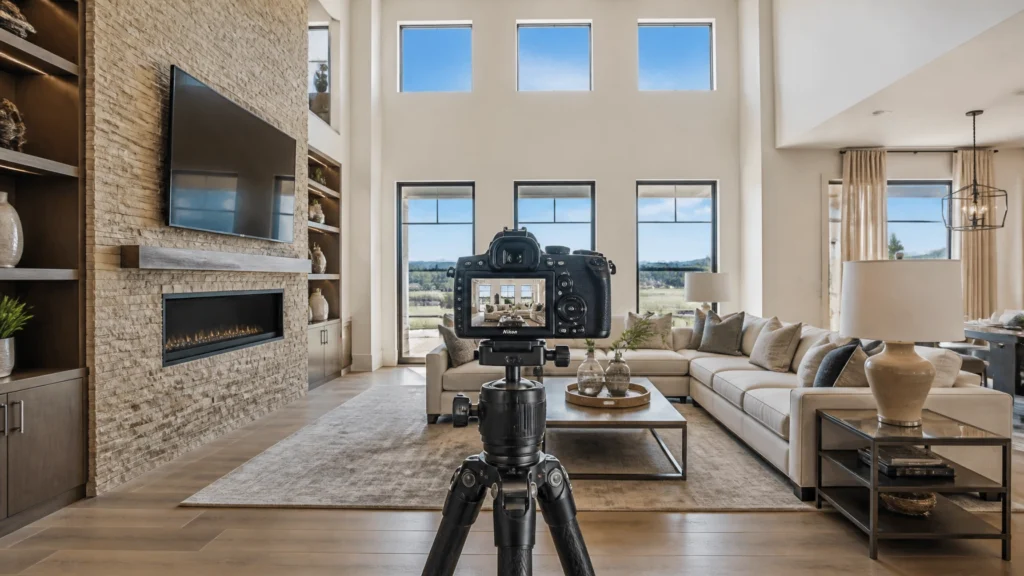
For over 14 years and more than 10,000 homes photographed, my workflow used to follow a very predictable, painful pattern. I’d spend two hours on-site, then spend another four hours hunched over a keyboard, manually masking windows, balancing color casts, and merging HDR brackets.
Back then, pricing was simple. I calculated how much my time was worth, added some overhead, and hoped I was making a profit.
But the world has changed. With the rise of tools like AutoHDR and other AI-driven editing platforms, that four-hour editing block has shrunk to fifteen minutes. If you are still pricing your services based on how long it takes you to work, you are effectively giving yourself a pay cut every time you get more efficient.
AI editing isn’t just a tool to help you “shoot faster”, it’s a fundamental shift in how we need to think about our business systems and pricing models.
The Death of the “Hourly Rate” Trap
The biggest mistake I see photographers making is sticking to a time-plus-materials pricing mindset. In the old days, if a client asked why a shoot cost $300, you could justify it by saying, “Well, it takes me two hours to shoot and four hours to edit.”
In 2026, that argument is dead. If AI can edit those photos in seconds for about $0.10 an image, the “labor” component of your invoice has vanished.
If you continue to price based on time, your income will plummet as technology improves. Instead, we have to move toward Value-Based Pricing. Your clients aren’t paying for your hours; they are paying for a set of assets that help them sell a house faster and for more money. Whether it took you ten hours or ten minutes to produce those assets is irrelevant to the homeowner or the Realtor.

How AI Changes Your Profit Margins
Let’s look at the math. In a traditional manual workflow, your biggest “cost” is your time (or what you pay an editor).
| Task | Traditional Workflow | AI-Assisted Workflow |
|---|---|---|
| On-site Capture | 60-90 Minutes | 60 Minutes (Systems-based) |
| File Management | 20 Minutes | 5 Minutes |
| Editing (30 Photos) | 2-4 Hours | 10-15 Minutes |
| Total Labor | ~5.5 Hours | ~1.3 Hours |
By implementing automated business systems, you’ve reclaimed over four hours of your day. If you keep your price the same, your hourly profit has effectively tripled.
This is the “AI Margin.” It’s the gap between the perceived market value of a high-quality photo and the drastically reduced cost of producing it. To protect this margin, you must stop talking about “editing” as a service and start talking about “delivery” and “image quality.”
Restructuring Your Packages for 2026
When AI commoditizes the “basic” edit, you need a tiered pricing structure that reflects different levels of complexity and value. I recommend a three-tier approach:
1. The Standard Media Package (AI-Primary)
This is your bread-and-butter package for average listings. It uses 100% AI editing for speed.
- Pricing Strategy: Competitive, high volume.
- Workflow: Shoot, upload to an AI processor, deliver.
- Value Proposition: Speed and consistency.
2. The Professional Tier (AI + Human Quality Control)
This is for your standard “good” homes where a Realtor wants a bit more polish.
- Pricing Strategy: 1.5x the base rate.
- Workflow: AI handles the heavy lifting; you spend 15 minutes doing “window pulls” or fine-tuning color.
- Value Proposition: Superior realism and attention to detail.
3. The Luxury/Architectural Tier (Human-Centric)
For high-end properties where AI still struggles with complex textures or extremely nuanced lighting.
- Pricing Strategy: 3x – 5x the base rate.
- Workflow: Manual blending, flash-ambient (Flambient) techniques, and artistic retouching.
- Value Proposition: Bespoke, magazine-quality artistry.

Upselling “Instant” Assets
AI has also turned what used to be expensive, time-consuming “premium” services into low-cost add-ons. You can now offer these with massive markups because the effort required from you is nearly zero.
- Virtual Twilight: Why wait for the sun to go down? AI twilight conversions take seconds and can be sold as a $25–$50 add-on.
- Virtual Staging: Tools can now stage a room for a fraction of the price of a manual editor. You can offer this for $30/image, while it costs you pennies.
- AI Floor Plans: Services like CubiCasa allow you to scan a house in 5 minutes and deliver a professional floor plan.
By including these in your pricing menu, you are increasing your “Revenue Per Rooftop” without significantly increasing your time on-site.
The “Experience” Premium
As editing becomes a commodity, the only thing AI can’t replace is you: your professional presence on-site, your reliability, and your ability to solve problems for the Realtor.
I’ve always said that real estate photography is 20% photography and 80% customer service and business systems. Your pricing should reflect the Client Experience.
- Do you show up on time?
- Is your delivery portal easy to use?
- Do you offer “Next Morning” delivery? (Made possible only by AI editing!)
If you can deliver photos by 9:00 AM the next day because your AI processed them while you slept, that is a premium service you can charge for.

Final Verdict: Adapt or Get Left Behind
AI isn’t coming to take your job; it’s coming to take your editing. If you try to compete with AI on price for “basic” services, you will lose. But if you use AI to lower your costs while keeping your prices anchored to the value you provide, you will build a more profitable business than ever before.
In my experience, the photographers who thrive in this new era are those who treat AI as an “employee” that works for free. They let the AI handle the pixels so they can focus on the people: finding more clients, improving their marketing, and scaling their business beyond the lens.
Next Steps to Increase Your Profits:
- Audit your editing time: If you’re spending more than 20 minutes per house on editing, you’re losing money.
- Test an AI tool: Try out a batch HDR processor this week on your next shoot.
- Update your Pricing: Move away from “per hour” talk and start bundling based on “Listing Success.”
Ready to build a more efficient business? Check out our Recommended Gear to see the exact tools we use to shoot faster and earn more.