
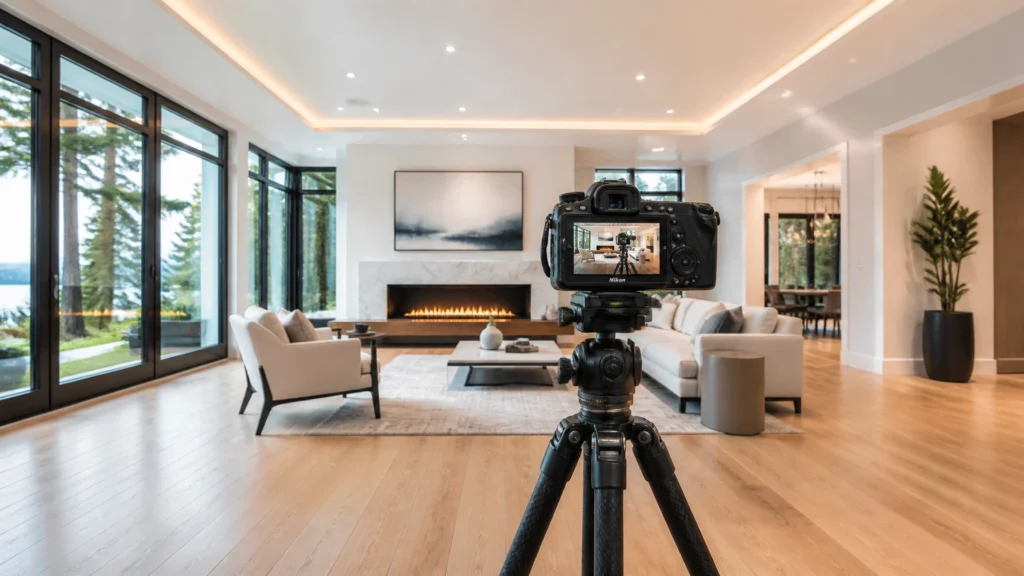
When Nikon announced the Z30, the marketing was clear: this is a camera for vloggers, TikTokers, and content creators. It was designed to be small, light, and “screen-centric.” But in the world of real estate media, we are always looking for the most efficient, cost-effective tool to get the job done. With over 14 years in the business and 10,000+ homes photographed, I’ve seen cameras come and go, and I’ve learned that the “intended” use of a camera doesn’t always dictate its value in the field.
The question I get asked often is: “Scott, can I use the Nikon Z30 for real estate photography, or is it just a toy for YouTubers?”
In this guide, I’m going to strip away the marketing fluff and tell you exactly how the Nikon Z30 performs when you’re standing in a cramped half-bath or trying to balance a blown-out window in a luxury high-rise. We’ll look at the specs that actually matter for our industry and decide if this budget-friendly Nikon belongs in your gear bag.
1. Quick Verdict
Is the Nikon Z30 recommended for real estate photography?
Yes, but with significant caveats. If you are a video-first creator or a beginner on a strict budget who already owns Nikon glass, the Z30 is a capable entry point. However, for serious, high-volume real estate photographers, the lack of an Electronic Viewfinder (EVF) and the APS-C sensor’s dynamic range limitations make it a secondary choice compared to the Nikon Z5 or the Canon R10.
- Who is it for? New photographers, video-centric real estate media pros, and those needing a lightweight “B-cam” for social media content.
- Worth buying today? Only if you find a great deal or specifically need its compact video features. If you primarily shoot stills, there are better specialized options.
2. Why I Recommend (and Why I Hesitate)
I’ve used almost every Nikon system from the early DSLRs to the high-end Z9. The Z30 occupies a weird space. On one hand, its portability is a dream. When you’re lugging gear through five houses a day, every ounce matters.
The Z30 solves the problem of “entry-level friction.” It’s approachable and has a fantastic articulating screen that makes shooting low-angle floor shots or high-angle kitchen shots much easier than a fixed or tilt-only screen.
However, my hesitation comes from the lack of a viewfinder. In real estate, we often find ourselves shooting exteriors in the high-noon sun. Without an EVF, you are flying blind, trying to judge your vertical lines and exposure on a glare-heavy LCD screen. For a professional, that’s a workflow bottleneck. If you’re willing to work around that, the Z30 can deliver professional results, but it requires more effort than its big brothers.
3. Key Features That Matter for Real Estate
When we look at a camera, we don’t care about “eye-autofocus for cats.” We care about four things: Dynamic Range, Bracketing, Wide-angle lens availability, and Workflow speed.
The Sensor: 20.9MP DX (APS-C)
The Z30 uses the same sensor found in the Z50 and the legendary D500. While it’s not full-frame, this sensor is a workhorse. It provides enough resolution for any listing (you only need about 12MP for the MLS anyway) and has decent low-light performance.
Auto Exposure Bracketing (AEB)
Nikon’s bracketing has always been reliable. The Z30 allows you to fire off brackets (usually 3 or 5 frames) quickly. This is essential for our HDR workflows. If you can’t bracket quickly, you’re losing money on every shoot.
Fully Articulating Screen
This is the Z30’s secret weapon. In real estate, we often have to shove a tripod into a corner or drop it low to show off hardwood floors. The ability to flip that screen out and see exactly what you’re doing from any angle is a massive advantage over the Nikon Z5’s limited tilt screen.
No EVF (Electronic Viewfinder)
We have to address the elephant in the room. There is no viewfinder. For interior work on a tripod, this isn’t a dealbreaker. For exterior shots or “run-and-gun” video, it is a significant limitation. You will need to invest in a high-quality screen hood or a bright external monitor if you plan to shoot in bright sunlight.
4. Real-World Performance: In the House
Let’s talk about how this camera actually behaves when you’re on the clock.
Handling Windows and Shadows
One of the hallmarks of high-end real estate photography is the “window pull”, making sure the interior is bright while the view outside the window is perfectly exposed. The Z30’s APS-C sensor has good dynamic range, but it’s not full-frame. In a dark room with a very bright window, you will find more “noise” in the recovered shadows than you would with a Nikon Z6II.
However, if you are using a proven HDR workflow or shooting “flambient” (flash + ambient), the Z30 handles the job just fine. It’s all about how you manage the light.
Vertical Lines and Composition
Precision is everything. If your vertical lines aren’t straight, the house looks like it’s falling down. The Z30 features built-in grid lines and an electronic level. Even without an EVF, you can maintain architectural accuracy. The EXPEED 6 processor also handles in-camera lens corrections beautifully, keeping your wide-angle shots from looking like a “fish-eye” mess.

5. Workflow Advantages: Speed and Consistency
In our RE Media Systems training, we emphasize shooting faster to earn more. Does the Z30 help with that?
- Size: It’s tiny. You can fit the Z30, a wide-angle lens, and a couple of batteries into a tiny shoulder bag. This makes moving through a property incredibly fast.
- SnapBridge: Nikon’s wireless transfer app, SnapBridge, works quite well with the Z30. If you need to send a “teaser” photo to an agent while you’re still on-site, the workflow is seamless.
- Video-to-Photo Toggle: The dedicated switch to move between photo and video modes is great. If you’re offering “Video Walkthroughs” as an add-on, the Z30 transitions faster than many older DSLRs.
6. Pros: Why It Might Win You Over
- Price Point: It is one of the most affordable ways to get into the Nikon Z ecosystem.
- Excellent Video: 4K/30p with no crop is fantastic for real estate video tours.
- The DX 12-28mm Lens: Nikon recently released the 12-28mm PZ lens, which is a perfect match for this camera. It’s wide enough for almost any room and very affordable.
- USB-C Charging: You can charge the camera via a power bank in your car between shoots. This is a lifesaver on 5-shoot days.
7. Cons: The Honest Truth
- No EVF: I can’t state this enough. Shooting exteriors in the sun is frustrating.
- Battery Life: It uses the smaller EN-EL25 battery. You will need 3 or 4 of these for a full day of shooting.
- APS-C Limitations: If you are shooting for high-end architectural magazines, the noise levels in the shadows might bother you. For standard MLS work, it’s fine.
- Ergonomics: For people with large hands, the body might feel too small and cramped for long days of shooting.
8. Who Should Buy This Camera?
- The Budget Beginner: If you are just starting and have $800 to spend on a body and lens, the Z30 is a great way to start earning.
- The Social Media Agent: If you are an agent who wants to take their own “pro-level” photos and high-quality TikTok/Reel content, this is the perfect hybrid tool.
- The B-Cam Specialist: If you already shoot with a Nikon Z7II and want a small, light camera specifically for your video walk-throughs, the Z30 fits perfectly.
9. Who Should Skip It?
- The Full-Time Pro: If you are shooting 10-15 homes a week, the lack of an EVF and the smaller batteries will eventually drive you crazy. Invest in a Nikon Z5 or Z6II instead.
- Exterior-Heavy Shooters: If you live in a sunny climate (Florida, Arizona, etc.), the glare on the LCD screen will make your life miserable.
10. Recommended Accessories
To make the Nikon Z30 a viable real estate tool, you need the right support:
- Lens: Nikon Z DX 12-28mm f/3.5-5.6 PZ VR. This is non-negotiable. You need that 12mm (18mm equivalent) for small rooms.
- Tripod: A solid carbon fiber tripod like the Peak Design Travel Tripod or a Manfrotto BeFree.
- Batteries: At least three EN-EL25 spares.
- LCD Sun Shade: A fold-out hood to help you see the screen outdoors.
- Memory Card: A fast V30 SD card (like SanDisk Extreme Pro) to handle 4K video without buffering.
11. Alternatives: How It Compares
How does the Z30 stack up against the competition?
| Feature | Nikon Z30 | Canon R10 | Sony a6700 |
|---|---|---|---|
| Viewfinder (EVF) | No | Yes | Yes |
| Sensor | 20.9MP APS-C | 24.2MP APS-C | 26MP APS-C |
| Video | 4K/30p (No Crop) | 4K/60p (Cropped) | 4K/120p |
| Screen | Fully Articulating | Fully Articulating | Fully Articulating |
| Best Lens for RE | DX 12-28mm | RF-S 10-18mm | Sony 10-20mm |
Nikon Z30 vs. Canon R10: The R10 is a much better “stills” camera because it has a viewfinder. However, Nikon’s 12-28mm lens is arguably better for video than Canon’s entry-level wide zooms.
Nikon Z30 vs. Sony a6700: The Sony a6700 is a superior camera in every technical way (better AF, better sensor, better video), but it also costs nearly double. If you have the budget, the Sony is the better professional choice.
12. FAQ: 10 Practical Buying Questions
1. Can the Nikon Z30 do HDR bracketing?
Yes. It supports Auto Exposure Bracketing (AEB), allowing you to capture the frames needed for high-quality real estate HDR images.
2. Is 20.9 megapixels enough for real estate?
Absolutely. Most MLS systems downsize images to around 2-4 megapixels. 20.9MP gives you plenty of room to crop and still have high-resolution files for print brochures.
3. Does it have a “Quiet Mode” for shooting in occupied homes?
Yes, it has a silent shutter option (electronic shutter), which is great for staying unobtrusive if the homeowner is working in the next room.
4. How is the battery life when shooting video?
It’s average. You’ll get about 45-60 minutes of actual recording time. For a standard 2-minute real estate walkthrough video, you can usually get through 2 houses on one battery.
5. Does the Nikon Z30 have Image Stabilization (IBIS)?
No, it does not have In-Body Image Stabilization. However, many DX lenses (like the 12-28mm) have built-in Vibration Reduction (VR), which is essential for handheld video.
6. Is the autofocus fast enough for real estate?
Real estate doesn’t move, so AF speed isn’t a huge factor, but the Z30’s AF is excellent. It’s much better than older DSLRs and focuses reliably in dim hallways.
7. Can I use my old Nikon F-mount lenses on the Z30?
Yes, but you will need the FTZ II Adapter. Keep in mind that older “DX” wide-angle lenses might be bulky on this small body.
8. Does it overheat during long video shoots?
The Z30 is actually better at heat management than the Z6 or Z7 because it doesn’t have an EVF box trapping heat. It can record for up to 125 minutes continuously.
9. Is the screen bright enough for outdoor use?
It’s decent, but not amazing. In direct summer sun, you will struggle. I highly recommend a screen loupe or a shade.
10. Is the Z30 weather-sealed?
It has some basic seals, but it is not a professional weather-sealed body. Don’t take it out in a downpour.
13. Final Recommendation
The Nikon Z30 is a bit of a “wolf in sheep’s clothing.” It looks like a simple vlogging camera, but inside is a sensor and processor capable of delivering top-tier real estate media.
My final take: If you are a dedicated professional photographer who spends 8 hours a day with a camera to your eye, skip the Z30 and buy a Nikon Z5. The Z5 is full-frame, has an EVF, and is much better suited for high-volume architectural work.
However, if you are a hybrid shooter who does 50% photos and 50% video, or if you are a beginner looking for the cheapest entry into the Nikon Z system, the Z30 is a fantastic tool. When paired with the Nikon DX 12-28mm lens, it becomes a compact, efficient “money-maker” that can help you build a profitable real estate media business.
In this industry, the best camera is the one that helps you shoot faster and earn more. If the Z30’s small size and flip screen help you get through a house 10 minutes faster, then it’s the right tool for you.
Ready to Upgrade Your Gear?
Check out our full list of Recommended Camera Gear for Real Estate to see exactly what we use to photograph over 1,000 homes a year.
Watch our Video Review on YouTube: [Link to YouTube Video]
Subscribe to our Newsletter for more practical tips on building a 6-figure real estate media business.