
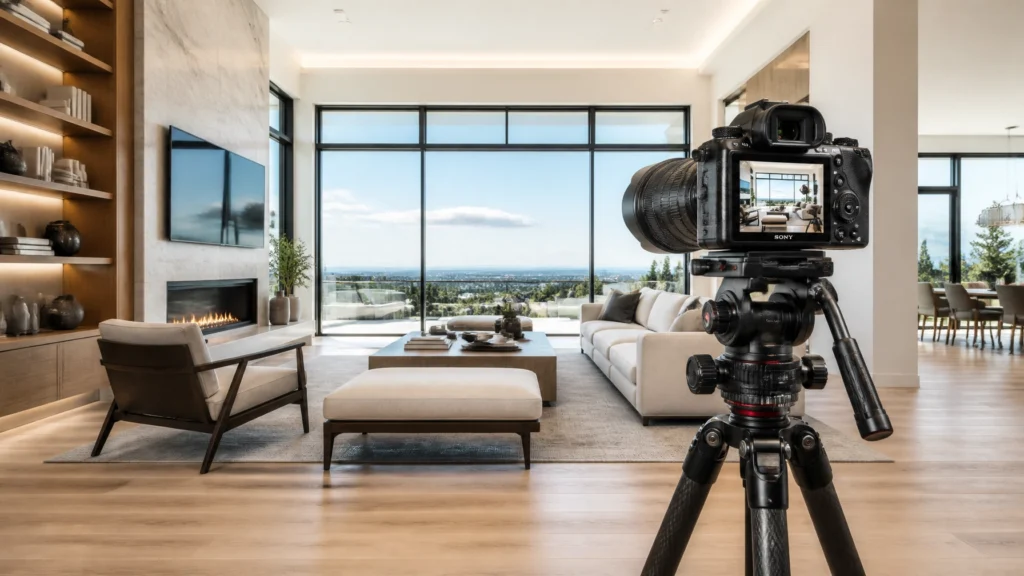
“If I had to start my real estate photography business from scratch today, I would not buy a single new piece of gear.”
That might sound like heresy coming from someone who has spent the last 14 years obsessing over cameras, lenses, and lighting. But after photographing over 10,000 homes since 2012, I’ve realized something that most beginners, and even many “starving artist” veterans, miss: Your camera gets you started, but your systems are what keep the business alive.
I wasted way too much time in the early years on the wrong things. I thought that if I just had a sharper lens or a more expensive tripod, the “six-figure” dream would magically materialize. It didn’t. What actually moved the needle were specific, intentional shifts in how I operated my business, not how I pushed the shutter.
In this guide, I’m breaking down the exact roadmap for building a profitable real estate media business in 2026. We are moving away from the manual, slow-motion workflows of the past and into a high-margin, automated business model that focuses on speed, scalability, and value-based pricing.
Shift #1: Stop Obsessing Over Gear, Start Obsessing Over Systems
I figured this out the hard way. You can shoot with a basic mirrorless camera and make great money if your systems for booking, shooting, editing, and delivering are tight.
I see it constantly: a new photographer spends three months researching the perfect wide-angle lens and the “best” full-frame body. They drop $4,000 on a kit, show up to their first shoot, and then have absolutely no idea how to price their work, how to deliver the files professionally, or how to follow up so that agent books them again next week.
That is completely backwards. Before you drop another dollar on gear, you need to map your workflow.
The Tech Stack Over the Lens
In 2026, your “tech stack” is more important than your lens choice. My systems rely on tools like:
- HD PhotoHub: For booking, delivery, and automated payment collection.
- AutoHDR.ai: For lightning-fast, high-quality image processing.
- CubiCasa: For generating floor plans in minutes using just a smartphone.
Your system is your real competitive advantage. When you have a documented workflow, you aren’t “winging it” every time a new lead comes in. You have a repeatable process that ensures a consistent client experience. That consistency is what builds a six-figure reputation.

Shift #2: The No-Tripod Workflow (Speed is Your Real Revenue)
When I started, I brought a tripod everywhere. I’d set it up in every room, level it, lock it down, shoot, move it, and repeat. That process added 15 to 20 minutes to every single house.
If you’re doing 3 to 5 shoots a day, you’re burning over an hour of your life just fiddling with tripod legs. In 2026, I would go handheld immediately.
IBIS + 3-Bracket HDR
Modern cameras like the Sony A7 IV or the A7 V have incredible In-Body Image Stabilization (IBIS). By using a wide-angle lens and a 3-bracket HDR setting, you can walk through a house like you’re on a mission.
- The Workflow: Walk in, find the angle, snap the brackets, and move.
- The Result: You cut your on-site time in half.
Speed on-site means you can fit more shoots into a single day without burning out. More shoots per day mean more revenue without working more hours. If you can get a 2,500-square-foot home done in 30 minutes instead of 60, you’ve just doubled your earning potential.

Shift #3: Build Packages, Don’t Sell Single Services
If you are still selling “25 photos for $150,” you are a commodity. You are competing with every other photographer in town on price alone, and that is a race to the bottom you will eventually lose.
The six-figure shift is to stop being a “photographer” and start being a marketing partner.
The Marketing Bundle Strategy
Agents don’t actually want “photos.” They want a sold sign in the yard and a happy seller. When you offer a complete marketing system, you solve their biggest problem: coordinating multiple vendors.
I recommend starting your base package at $250 minimum. Why? Because you aren’t just giving them photos. You are giving them:
- Professional Photos (The baseline)
- A Floor Plan (The #1 thing buyers want)
- A Virtual Tour or Drone Shots (The “wow” factor)
Agents want one call, one vendor, and one invoice. By bundling these services, you increase your Average Order Value (AOV) from $150 to $350 or $450 per shoot. It is much easier to hit six figures doing two $400 shoots a day than it is doing six $150 shoots.
Shift #4: Learn Floor Plans, Drone, and Video in Your First 6 Months
If you want to be profitable twice as fast, don’t wait until you “master” photography to add other services. In 2026, these aren’t “add-ons”, they are the core of the business.
Floor Plans (The Non-Negotiable)
According to Zillow, floor plans are the 2nd most important feature on a listing after photos. Tools like CubiCasa allow you to scan a home in 5 minutes with your phone. It costs you almost nothing in time but adds $50-$100 in pure profit to every invoice.
Drone and Video
I shoot drone photos on 60-70% of my jobs. It takes me 10 minutes to fly, snap 5-10 angles, and land. That’s another $75 to $100 added to the bill.
As for video, vertical walkthroughs for Instagram Reels and TikTok are the highest-growth area for agents right now. They need content to stay relevant. If you can provide a 30-second “Social Media Teaser” while you’re already there for photos, you’ve just become indispensable.

Shift #5: Stop Editing Your Own Photos , Use AI
This is where I see most photographers hit a glass ceiling. They shoot all morning, then come home and spend four hours editing in Lightroom and Photoshop every night.
If you are editing your own photos, you aren’t a business owner; you’re an editor who happens to own a camera.
The 70-90% Time Reduction
AI editing services like AutoHDR or specialized AI-assisted editors (like Forello) have completely changed the game. You upload your brackets, and the AI handles the window pulls, color balancing, and sky replacements.
Your job shifts from “pixel pushing” to Quality Control (QC). Instead of spending hours per shoot, you spend 5 to 10 minutes checking the AI’s work before delivery. This allows you to scale your volume without scaling your stress.
Don’t cling to manual workflows because they feel “more pure.” This is a business. Use the tools that give you your life back.

Shift #6: Price on Value, Not Fear
Most beginners undercharge because they are scared. They’re scared the agent will say no, or they’re scared they aren’t “good enough” yet.
Here is the truth: Your price signals your value.
If you charge $100, you will attract the “budget” agents who are the most demanding, have the worst listings, and will drop you the second someone else offers to do it for $90. If you charge $250+, you attract the professionals who value their time and want a reliable partner.
Stop Trying to Impress Photographers
I see people in Facebook groups arguing about megapixels and lens distortion all day long. Who cares? Your client: the realtor: doesn’t care about your gear. They care about:
- Does the house look amazing?
- Did you show up on time?
- Did you get the photos back to me within 24 hours so I can get the listing live?
Over 70% of agents say quality photos help them win more listings. That is what you are selling: The next listing. Sell the result, not the tech specs.
Shift #7: Document and Improve Your Workflow Weekly
When I started, I just “winged it.” Every shoot was a slightly different process. I wasted so much energy reinventing the wheel every Tuesday.
If I started over, I would write everything down from Day 1. I would have an SOP (Standard Operating Procedure) for:
- How I prep the house before shooting.
- The exact order of rooms I shoot (starting at the front door, ending at the backyard).
- My camera settings for every lighting scenario.
- My delivery email template.
The 5-Minute Improvement Mindset
Every Friday, I spend 15 minutes asking one question: “What one thing can I improve by 5 minutes or 5% this week?”
Maybe it’s a better email template that stops a client from asking the same question twice. Maybe it’s a faster way to cull images. These tiny improvements compound. In six months, you’ll be faster. In a year, you’ll be a machine. This is how you build a six-figure business that doesn’t require 80 hours a week to maintain.

Mindset: Serve Realtors, Don’t Impress Photographers
The six-figure photographers in this industry aren’t necessarily the best technical artists. They are the ones who understand the real estate business better than their competition.
They know that an agent is stressed about a deadline. They know that a homeowner is nervous about selling their biggest asset. They know that a floor plan helps a buyer visualize their furniture in the space.
When you shift your mindset from “Look at my pretty pictures” to “How can I help this agent sell this house faster and win their next listing,” your income will skyrocket.
Conclusion: Systems Keep the Business Alive
Your camera gets you started. It’s the entry ticket. But your systems: your speed, your packages, your AI editing, and your pricing: are what will make you profitable.
If you are tired of the “starving artist” grind, it’s time to stop looking at gear and start looking at your business model.
Want to dive deeper into the systems we use to run a high-volume real estate media company?
- Read our Complete Guide to Starting a Real Estate Photography Business.
- Check out the Sony A7 V Review to see why we love the latest IBIS for the no-tripod workflow.
- Stay tuned for our upcoming Ultimate HDR Guide where we dive into the technical side of the 3-bracket workflow.
If this helped you, drop a comment on the YouTube video and let me know which shift you’re going to implement first. I’m Scott Prokop, and I’m here to help you shoot faster, earn more, and build a better business.
Pingback: Real Estate Photography Editing Workflow: The Proven System for High-Volume Success (2026 Edition) - RE Media Systems