
Let’s be honest: if you’re still calling yourself “just a photographer” in 2026, you’re leaving thousands of dollars on the table every single month.
After 14 years in this industry and more than 10,000 homes photographed, I’ve seen the market shift from a “nice-to-have” luxury to a high-speed, multi-asset necessity. Today, real estate agents aren’t looking for someone to just click a shutter; they’re looking for a Marketing Partner.
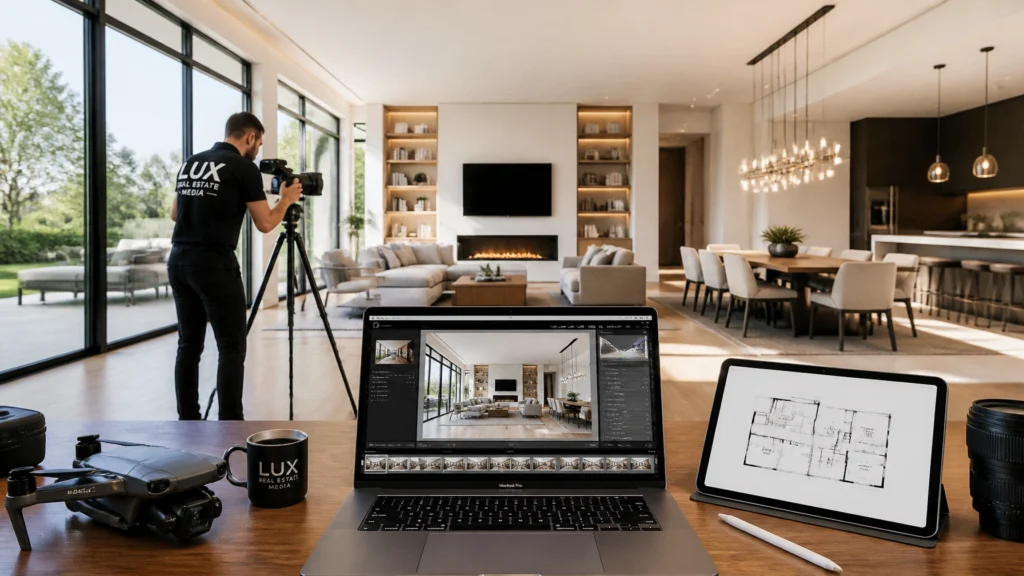
They want a one-stop-shop that can walk into a home and walk out 60 minutes later with everything needed to launch a listing: pro-level HDR photos, cinematic video, accurate floor plans, and drone coverage.
In this guide, I’m going to show you exactly how to build a full-service portfolio that makes you indispensable to your clients and significantly more profitable.
The Hierarchy of Real Estate Media: Needs vs. Wants
Not every listing is a $5M mansion, but every listing needs a baseline level of professional media. To build a sustainable business, you need to understand the hierarchy of services.
- The Baseline (Must-Haves): Professional HDR Photography and 2D Floor Plans. In 2026, these are the bare minimum.
- The Standard Bundle: Photos + Floor Plans + Drone. Most mid-range suburban homes fall here.
- The Luxury Suite: Photos + Floor Plans + Drone + Cinematic Video + Virtual Staging + Twilight. This is where you maximize your per-shoot earnings.
By offering a tiered approach, you cater to the budget-conscious agent while staying ready to capture the high-end commissions.
If you’re brand new, don’t feel like you need to launch every service at once. One of the biggest mistakes I see photographers make is trying to look like a full production company before they’ve built a repeatable core workflow. After 14 years in this business and more than 10,000 homes photographed, I can tell you the better path is to build your service ladder in the same order clients naturally buy it.
Start with the essentials. Get really good at clean, consistent HDR photography. Add floor plans once you can shoot a standard listing efficiently. Layer in drone coverage when you’re confident with airspace rules, safety, and fast on-site execution. Then add video, virtual staging, and premium upsells once your baseline package is profitable and your turnaround is under control.
That matters because every additional service changes your workflow, pricing, communication, editing, and delivery. If your systems are weak, adding more services just creates more chaos. If your systems are strong, each new add-on increases your average order value without wrecking your schedule.
A practical way to think about it is this:
- Photography builds trust.
- Floor plans add logic and usefulness.
- Drone adds context and perceived value.
- Video adds emotion and marketing power.
- Virtual services add margin.
That’s the progression I’d recommend for most photographers who want to shoot faster, earn more, and build a better business instead of just staying busy.
If you want the broader roadmap for building the business side first, start with our Start Here / Business Guide.
Service 1: Professional Real Estate Photography (The Baseline)
Professional photography remains the foundation of everything we do. However, the standard has moved beyond just “decent” shots. In 2026, agents expect perfect rectilinear wide-angle views, crystal clear window pulls, and vertical lines that are 100% straight.
We use a systematic HDR (High Dynamic Range) approach to ensure we capture detail in the darkest corners and the brightest windows. This consistency is what builds trust with your clients.
What matters here is consistency, not just image quality in a vacuum. Agents don’t build loyalty because you made one dramatic living room photo. They build loyalty because every listing you shoot looks clean, bright, straight, and market-ready without surprises. That kind of consistency comes from having a repeatable shooting method, a lens you trust, a tripod setup that’s fast, and an editing workflow that doesn’t fall apart when you’re busy.
In practical terms, your photography service should do three things well:
- Represent the property accurately
- Make the home look bright and inviting
- Be efficient enough to support profitable pricing
If you can’t shoot a typical listing quickly while maintaining straight lines, natural color, and solid window detail, the rest of your service menu won’t save you. Photography is still the core product. Everything else is an add-on to that foundation.
If you’re still refining your setup, also check out our Best Gear Guide for the camera, lens, tripod, and support gear that keeps this process efficient.
Key Technical Requirements:
- Straight Verticals: Use a sturdy tripod and a geared head to ensure your camera is perfectly level.
- Wide-Angle (but not Fisheye): Usually 16mm to 24mm on a full-frame sensor.
- Balanced Lighting: Ensuring the interior feels warm and inviting while the view out the window looks like a postcard.
For a deep dive into the exact settings I use, check out our Ultimate Guide to Real Estate HDR Photography.
Service 2: Drone Photography & Video (The Context)
Drone media is no longer an “extra”, it’s the context. Buyers want to see how a house sits on the lot, where the property lines are, and how close they are to that park or school.

In Canada, staying compliant with Transport Canada licensing is non-negotiable. Whether you’re flying a sub-250g micro-drone or a larger professional rig, you need to be legal.
The important thing to understand is that drone work should support the listing, not slow the whole appointment down. I see a lot of photographers overcomplicate this. They fly too long, gather too much footage, or chase flashy angles that don’t actually help the agent market the property. For most listings, the goal is simple: clearly show the lot, the setting, and the features buyers can’t understand from ground level.
That usually means your drone workflow should be fast and disciplined:
- Get the hero angles first in case wind or weather changes.
- Show what matters most: lot size, backing area, views, amenities, outbuildings, or proximity.
- Don’t overdeliver random aerials that create more culling and editing time.
- Stay safe, legal, and predictable every single shoot.
From a business perspective, drone is powerful because it increases perceived value without adding a huge amount of on-site time once you know what you’re doing. It’s one of the easiest ways to make a package feel more complete and more premium.
The 6-Shot Drone Checklist:
- The Front Hero: High-angle shot of the facade.
- The Backyard Lifestyle: Showing the pool or deck.
- The Neighborhood Context: The home in relation to local amenities.
- The Top-Down (Bird’s Eye): Perfect for adding digital property lines.
- The Surroundings: Major cross-streets or landmarks.
- The Reveal: A slow cinematic orbit or pull-away.
Learn more in The Ultimate Guide to Real Estate Drone Photography.
Service 3: Cinematic Property Video (The Emotion)
There is a massive difference between a “walkthrough” and a “cinematic tour.” In 2026, the demand has shifted toward vertical social media content (Reels/TikTok) over traditional long-form YouTube videos.
I highly recommend tools like the DJI Osmo Pocket 4 (or the latest stabilized compact gimbal). It allows you to move through a home with incredible speed while delivering 4K vertical footage that looks like a high-budget production.
The practical shift photographers need to understand is that video doesn’t have to mean a massive production day. For most real estate media businesses, the most profitable video service is not a cinematic masterpiece with hours of filming and a complicated edit. It’s a fast, clean, repeatable deliverable that helps the agent market the listing on social media.
That’s why short-form vertical video matters so much right now. It matches how agents actually promote listings. It’s easier to sell as an add-on. And if you use the right camera movement and keep the shot list simple, it can fit into a standard appointment without destroying your schedule.
A few things matter a lot in real-world video work:
- Stabilization matters more than exotic camera specs.
- Simpler camera moves usually look more professional.
- Good pacing beats long runtime.
- Agents care about usability and speed more than film-school creativity.
If you’re adding video for the first time, treat it like a productized service. Define the runtime, define the format, define what’s included, and keep your shooting sequence tight. That’s how you make video profitable instead of stressful.
Focus on:
- The First 3 Seconds: Hook the viewer with the best feature of the house (the kitchen or the view).
- Agent Branding: Include clips of the agent on-camera to help build their personal brand.
- Short & Punchy: Keep social reels under 60 seconds.
Service 4: 2D & 3D Floor Plans (The Logic)
Buyers are logical. They need to know if their king-sized bed fits in the primary suite. This is why floor plans have become the #1 most requested add-on.
We use CubiCasa and iGUIDE to generate these. These systems allow you to scan a home in 5-10 minutes using your smartphone or a specialized camera like the iGUIDE PLANIX.

By adding floor plans to your workflow, you can add $50-$100 to every invoice with almost zero extra work on-site.
This is one of the easiest services to justify because buyers actually use it. A floor plan helps answer practical questions that photography alone cannot: room flow, dimensions, furniture fit, and layout logic. That makes it valuable not just as an upsell, but as part of a more complete listing package.
From a business standpoint, floor plans also solve another problem: they help increase order value without requiring advanced creative skill. You don’t need to become a better artist to sell them. You need a reliable capture process, a clear pricing structure, and a simple explanation of why they matter.
Here’s why I like floor plans as an add-on for growing media businesses:
- They’re easy for agents to understand.
- They increase the usefulness of the listing.
- They fit naturally into a standard appointment.
- They help differentiate your package from photographers who only offer stills.
- They usually create strong profit relative to the time invested.
If you want to compare the main platforms, especially if you’re deciding between quick smartphone capture and more measurement-focused systems, our CubiCasa and iGUIDE resources are worth reviewing alongside your service strategy.
Service 5: Virtual Staging & Twilight (The “Fix-it” Services)
Empty rooms don’t sell; they look cold and small. But traditional staging is expensive. Virtual Staging is the solution. Using AI-driven tools, you can “furnish” a home for a fraction of the cost, helping buyers visualize the lifestyle.
Similarly, Virtual Twilight is a game-changer. Instead of returning to a property at 9:00 PM to catch the “blue hour,” you can take a daytime exterior shot and have it edited into a stunning sunset scene. It saves you a trip and saves the agent money.
These are what I think of as margin-friendly services. They solve a marketing problem for the agent without requiring a full second appointment, a truckload of extra gear, or a major increase in your on-site time. That makes them especially useful once you already have a strong photography workflow in place.
The key is to offer them ethically and selectively. Not every room needs virtual staging. Not every property needs a twilight image. Reader trust matters, and client trust matters too. If a service genuinely helps the home present better and the listing market faster, recommend it. If it’s just being added to pad the invoice, don’t.
A practical approach is:
- Offer virtual staging for vacant homes where scale and livability are hard to visualize.
- Offer virtual twilight when the front exterior has strong curb appeal and would benefit from a premium hero look.
- Explain what is edited and where it will be used.
- Keep examples ready so the agent can see the before-and-after value quickly.
This is also where having clear package design helps. When an agent understands which add-ons solve which listing problems, they make decisions faster and trust your recommendations more.
Service 6: Agent Branding & Social Media Content
The most successful photographers in 2026 are those who help agents become “content creators.” This means offering:
- Professional Headshots: On-location during the shoot.
- “Just Listed” Clips: Quick 15-second “behind the scenes” videos for the agent’s Instagram.
- Neighborhood Snapshots: Quick drone clips of the local community.
When you help an agent build their brand, they stop shopping on price and start valuing your partnership.
That’s a huge shift, and it’s one of the smartest ways to protect your business from pure price competition. If your only role is delivering listing photos, some agents will always compare you to the cheapest option in town. But when you help them market themselves, create consistent content, and look more professional online, you become harder to replace.
This doesn’t mean you need to become a full-blown marketing agency. It just means paying attention to the assets agents repeatedly need beyond the MLS gallery. In real-world terms, that might be:
- a quick headshot refresh,
- a branded intro clip,
- a few vertical behind-the-scenes clips,
- neighborhood detail shots,
- or a simple library of reusable social content.
These services are valuable because they tie your business to the agent’s long-term visibility, not just one listing at a time. That leads to better retention, more repeat work, and better conversations about bundled services.
If your goal is to build a more durable business instead of constantly chasing the next one-off shoot, this category is worth taking seriously.
Systems & Delivery: The 24-Hour Rule
In real estate, speed is everything. If you take three days to deliver photos, you’ve already lost. Your goal should be next-morning delivery.
We use HD PhotoHub and the RE Media Systems / Scott Prokop App to automate this.
- Upload: Send your RAW files to your editors immediately after the shoot.
- Review: Quality check them first thing in the morning.
- Automated Billing: The client gets a preview and must pay before downloading high-res files.
This system ensures you get paid on time, every time, without chasing invoices.
A lot of photographers focus heavily on capture and gear but ignore delivery systems, and that’s a mistake. The backend is where your business either feels professional or starts leaking time and money. Fast delivery matters, but so do organization, communication, invoicing, file management, and clear client expectations.
Here’s the practical reality: if your post-shoot process is messy, every additional service becomes harder to manage. More files, more revisions, more missed details, more late nights, and more admin work. On the other hand, when your workflow is streamlined, adding services like drone, floor plans, reels, and staging becomes far more manageable.
A solid delivery system should help you do the following:
- Move files quickly from camera to editor or editing queue
- Keep naming and organization consistent
- Review efficiently without bottlenecks
- Deliver on schedule with clear next steps for the client
- Collect payment cleanly without awkward follow-up
If you want to tighten this part of the business, our Editing Guide is a good next step because editing speed and delivery systems go hand in hand.
Pricing & Bundling: Maximize Your Profit
Stop selling “25 photos” for $150. Instead, sell “The Professional Marketing Package” for $495.
Sample Bundle Strategy:
- Standard ($299): 25 HDR Photos + 2D Floor Plan.
- Executive ($495): 35 HDR Photos + 2D Floor Plan + Drone Stills + 60s Social Reel.
- Luxury ($895): All of the above + Virtual Twilight + Full Cinematic Video + Virtual Staging (up to 3 rooms).
The reason bundling works so well is simple: agents want clarity. They don’t want to decode a giant a la carte menu every time they book a listing. They want to know which package fits a basic property, which one fits a stronger marketing push, and which one is designed for premium listings.
Good packages also help you in three important ways:
- They increase average order value.
- They reduce decision fatigue for the client.
- They steer bookings toward the services that are most efficient and profitable for your business.
One thing I’ve learned from years of shooting is that price alone is rarely the whole issue. Confusion is often the real problem. When your menu is complicated, clients default to the cheapest option or ask for endless custom quotes. When your offers are simple and outcome-focused, they book faster.
A practical package structure should answer these questions:
- What does the average listing actually need?
- What add-ons are easy to explain and easy to fulfill?
- Which services create the best profit relative to your time?
- Where do you want to guide clients instead of letting them build random combinations?
Business Workflow: Shooting a Full Package in 60 Minutes
Efficiency is how you make the “big bucks.” Here is my exact 60-minute on-site workflow:
- Minute 0-10: Walkthrough and lights on.
- Minute 10-35: Interior Stills (HDR). Start from the farthest room and work back to the door.
- Minute 35-45: Floor Plan Scan (CubiCasa/iGUIDE).
- Minute 45-55: Drone (Exterior Hero & Neighborhood).
- Minute 55-60: Quick Social Video clips & pack up.
If you’re spending 3 hours at a 2,000 sq ft home, you’re overthinking it. Use the right gear, follow a system, and move with purpose.
That doesn’t mean rushing carelessly. It means eliminating wasted motion. The photographers who build sustainable businesses are usually the ones who know exactly what they’re doing next. They’re not wandering from room to room deciding on the fly. They’ve already built a repeatable sequence for stills, add-ons, and delivery.
A few practical habits make a massive difference here:
- Arrive with a standard entry routine.
- Use the same lens, tripod height, and room flow whenever possible.
- Batch similar tasks together instead of bouncing around.
- Capture only what supports the final product.
- Leave yourself enough margin for quick problem-solving without derailing the appointment.
This is where experience really pays off. After photographing more than 10,000 homes over 14 years, you start to realize that speed is less about moving faster physically and more about reducing decisions. Fewer unnecessary decisions means more consistency, less fatigue, and better profitability over time.
Common Mistakes to Avoid
- Overshooting: Don’t give them 100 photos of a 1,500 sq ft house. 25-35 high-quality shots are better than 100 mediocre ones.
- Complicated Gear: If it takes 20 minutes to set up, leave it in the car. Speed is profit.
- Slow Delivery: Anything longer than 24 hours is an “F” in this industry.
- Poor Communication: Always set expectations with the homeowner and the agent before you arrive.
- Adding services before building systems: Don’t bolt on drone, video, floor plans, and virtual staging if your core photo workflow is still inconsistent.
- Undervaluing floor plans and video: A lot of photographers leave money on the table by treating these as occasional extras instead of structured package components.
- Trying to win on price alone: Competing only on price usually attracts the wrong clients and leads to burnout.
- Ignoring the business side: Great images won’t fix weak pricing, sloppy delivery, or poor follow-up.
FAQ: Building Your Real Estate Media Business
1. Do I need a drone license for every shoot?
Yes. In Canada, if you are flying for “work,” you need to be compliant. Use a sub-250g drone if you want fewer restrictions, but keep your certificate current.
2. Is Matterport still worth it in 2026?
It depends. For luxury listings, yes. For standard homes, a 2D floor plan with high-quality stills is often enough.
3. What is the best camera for beginners?
A Sony A7 series (like the A7IV or A7R V) is the industry standard for its dynamic range and autofocus.
4. How do I find new clients?
Instagram is your portfolio. Tag agents, use local hashtags, and offer a “first shoot” discount to get your foot in the door. Also make sure your services are packaged clearly so agents immediately understand the difference between your basic, standard, and premium offerings.
5. Should I edit my own photos?
No. Once you’re shooting 3+ homes a week, outsource your editing. Your time is worth more behind the camera than in front of a monitor. See our Editing Guide.
6. How much should I charge for travel?
Establish a “home zone.” Anything outside that should have a per-kilometer fee or a flat regional surcharge.
7. Can I shoot with just a smartphone?
For social reels, yes. For high-end MLS photos, no. Clients expect professional gear when they’re paying professional rates.
8. What floor plan app do you recommend?
CubiCasa is the easiest and most cost-effective for 2D plans. iGUIDE is superior for professional measurements and 3D tours.
9. How many photos should I deliver for a 3-bedroom home?
Usually between 25 and 35. You want to cover every room and the best exterior angles without being redundant.
10. Do I need insurance?
Absolutely. General liability insurance is a must when you’re walking through high-end homes with expensive equipment.
11. Is video more profitable than photography?
Per hour, yes. Video has a higher perceived value and requires less “polishing” if you use the right gimbal techniques.
12. How do I handle dark rooms?
Use a bracketed HDR approach. Take 3-5 exposures and blend them to pull detail out of the shadows.
13. What is “Virtual Twilight”?
It’s an editing service that converts a daytime photo into a sunset photo. It’s a great high-margin upsell.
14. Do I need to be present for the shoot?
Yes, but you can eventually scale by hiring “shooters” once your systems are in place.
15. Is real estate media a seasonal business?
Yes, spring and fall are peak. Use the winter months to refine your systems and reach out to new agents.
Final Roadmap: How to Scale One Service at a Time
Don’t try to launch everything tomorrow.
- Month 1: Master HDR Photography & 2D Floor Plans.
- Month 2: Add Drone Stills.
- Month 3: Introduce Social Reels (Vertical Video).
- Month 4: Package them together and raise your prices.
The transition from “photographer” to “marketing partner” is the single most important step you can take to build a six-figure real estate media business.
And the big takeaway is this: you do not need more random services. You need the right services, built on the right systems, delivered consistently. That’s what helps you shoot faster, earn more, and build a better business.
If I were starting or rebuilding a real estate media business today, I’d focus on five priorities:
- Dial in photography first. This is still the foundation of client trust.
- Add floor plans early. They’re useful, easy to explain, and profitable.
- Use drone strategically. Not for flash, but for context and value.
- Productize video. Keep it simple, fast, and relevant to how agents market listings today.
- Build backend systems. Fast delivery, clean invoicing, organized files, and clear packages are what let you scale.
That’s the practical path. It’s not flashy, but it works.
If you want to keep going, here’s the order I’d recommend:
- Read the Start Here / Business Guide for the overall roadmap.
- Review the pillar guides on Drone, HDR, Pricing, Gear, and Editing to strengthen each part of your workflow.
- Explore our Recommended Gear list.
- Watch our latest tutorials on the RE Media Systems YouTube Channel.
If your goal is to become a true one-stop-shop for agents, build it one profitable layer at a time.