
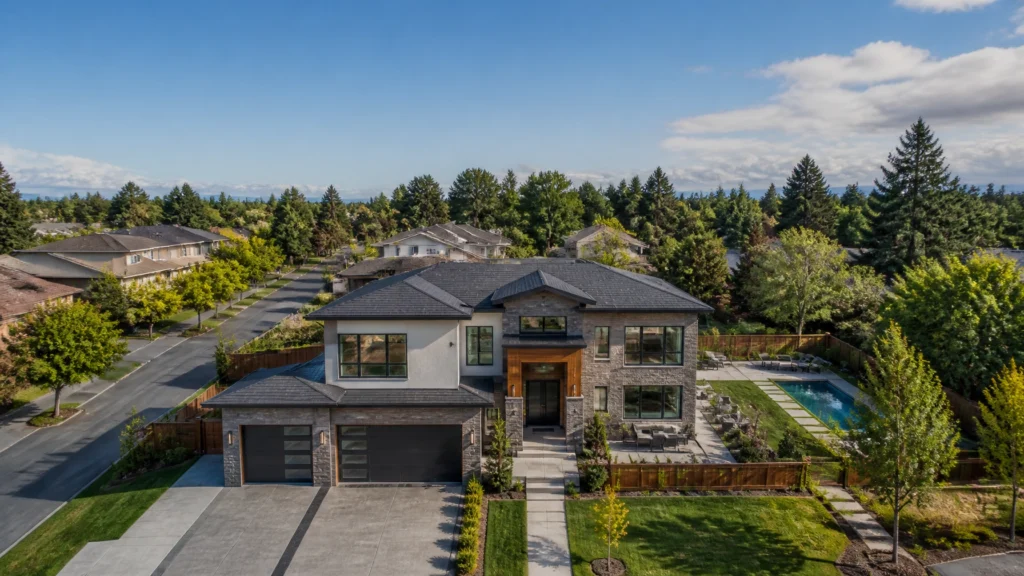
Drone photography is no longer just an impressive extra for luxury listings. The right aerial shots help buyers understand the property, its lot, its surroundings, and the lifestyle an agent is trying to sell.
But not every drone shot has the same value.
After more than 14 years as a full-time real estate photographer and photographing over 10,000 homes, I have learned that the best aerial images are not necessarily the highest or most dramatic. They are the images that answer questions a ground-level camera cannot.
Where does the property sit on the lot? How large is the backyard? Is the home close to a park, lake, golf course, or downtown? What does the property look like at the time of day when buyers are most emotionally engaged?
Those are the drone shots that help Realtors® market listings more effectively: and help photographers deliver a better service.
Why the Right Drone Shots Help Win Listings
A drone gives an agent more than another set of photographs. It gives them a way to tell the complete story of a property.
Traditional photography shows the home from the inside and the street. Aerial photography connects those views by showing:
- The relationship between the home, yard, driveway, and neighboring properties
- Outdoor features such as pools, decks, gardens, and detached garages
- The property’s position within the neighborhood
- Nearby amenities and lifestyle features
- A more memorable opening or closing for a listing video
The goal is not to add drone footage simply because you own a drone. The goal is to create marketing assets that make the agent look prepared and help the seller see more value in the listing package.
The Five Real Estate Drone Shots I Would Capture
1. The Elevated 45-Degree Establishing Shot
This is usually the most useful aerial still for a residential listing.
Position the drone high enough to see the home, front yard, driveway, and some surrounding context. Keep the camera angled toward the property rather than pointing straight down.
This shot should answer the buyer’s first question: What does the property look like as a whole?
For a typical home, I would capture several variations:
- A front-facing view showing curb appeal
- A rear view showing the backyard and outdoor living spaces
- A side angle showing the home’s position on the lot
- A wider frame that includes the street and immediate surroundings
Avoid flying so high that the home becomes a small object in the frame. Aerial photography is most effective when the property remains the subject.

2. The Top-Down Property and Lot Shot
A clean, straight-down image is one of the most informative real estate drone shots you can deliver.
Point the camera directly toward the ground and center the home or the most important part of the property. This perspective can show:
- Lot shape and approximate scale
- Driveway and parking layout
- Decks, patios, pools, and outbuildings
- Tree coverage
- The relationship between the home and yard
- Access to water, trails, green space, or other features
For larger properties, land listings, and acreage, this shot can be especially valuable.
However, be careful with property lines. Do not guess or draw legal boundaries based only on what you see in the image. If an agent wants parcel lines added, use reliable municipal, survey, or mapping data and clearly label the graphic as an approximate marketing overlay when appropriate.
The aerial image communicates context. It is not a legal survey.
3. The Neighborhood Lifestyle Shot
One of the biggest advantages of drone photography is that it can show buyers what exists beyond the property.
A neighborhood shot may include:
- A nearby park or playground
- A lake, river, or waterfront
- Golf courses and walking paths
- Schools or community facilities
- Downtown buildings and city views
- Shopping areas or major streets
- Acreage, farmland, or open space surrounding the home
The key is relevance. Do not simply fly high and record everything visible. Choose the features that matter to the likely buyer.
For a family home, a park or school may be more useful than a distant skyline. For an acreage property, the view, land, water, and road access may be the most important selling points.

This is also where drone footage can help an agent create a stronger listing presentation. Instead of saying, “The home is close to the park,” the agent can show it.
4. The Reveal or Approach Shot
For video, I like shots that create a clear sense of movement and discovery.
A simple approach shot can begin farther away and slowly move toward the home. A reveal can begin behind a tree, roofline, or other foreground element before sliding sideways to uncover the property.
These shots work because they create a natural sequence:
- Establish the surroundings.
- Guide the viewer toward the property.
- Reveal the home as the destination.
- Transition into the ground-level exterior or interior footage.
Keep the movement slow and intentional. Sudden yaw movements, fast ascents, and aggressive camera tilts usually make real estate video feel less polished.
For most residential listings, a short, smooth move is more useful than a complicated flight path.
5. The Twilight Drone Shot
Twilight aerials can give a listing a completely different emotional feel.
The best window is usually around blue hour, when the sky still has color but the home’s interior and exterior lights are visible. Turn on:
- Interior lights
- Porch lights
- Landscape lighting
- Pool or hot tub lights
- Garage and entry lighting
The contrast between a cool blue sky and warm windows creates depth and makes the property feel welcoming.

Twilight drone work requires more planning than daytime photography. Wind, low light, exposure, and battery management all become more important. Fly slowly, avoid unnecessary movement, and capture stills while the light is changing.
For video, use smooth movements and watch your exposure carefully. For stills, shoot RAW when available so you have more control over highlights, shadows, and color during editing.
The objective is not to make the home look artificially bright. It is to preserve the natural atmosphere while keeping the property clear and attractive.
How I Would Build a Repeatable Drone Workflow
A repeatable process helps you shoot faster and deliver consistent results.
Before launching, walk around the property and identify the features that deserve aerial coverage. Then organize the flight in this order:
- Wide establishing shot
- Front and rear elevated views
- Backyard and outdoor feature shots
- Top-down property view
- Neighborhood context
- Reveal or approach video
- Twilight shots, if included in the package
This sequence prevents you from wasting battery time deciding what to capture in the air.
It also makes the deliverables easier to explain to clients. Agents know they are receiving a complete aerial package rather than a random collection of drone images.
For editing, correct horizon tilt, lens distortion, exposure, and color consistency. Drone footage should match the look of the ground photography. If the interior images are bright and natural but the aerials are heavily saturated, the final marketing package will feel disconnected.
You can review related workflow resources through the 60-Minute Real Estate Photography Workflow and compare tools on the Recommended Gear page.
Choosing a Drone for Real Estate Work
The best drone is the one you can operate safely, efficiently, and consistently.
For my primary real estate drone workflow, I recommend considering the DJI Air 3S. Its dual-camera system provides flexibility for wide property views and more compressed perspectives, while its reliable deployment and obstacle-sensing features are useful when working around homes, trees, and other obstacles.
For photographers who prioritize portability and quick deployment, the DJI Mini 5 Pro is worth considering. Its lightweight design makes it convenient for tight neighborhoods, travel, and photographers who want to keep their kit compact.
Do not choose based on specifications alone. Consider the entire business workflow:
- How quickly can you set up?
- Can you capture the required stills and video on one visit?
- Is the image quality consistent with your ground photography?
- Can you safely operate in the environments where you work?
- Will the drone help you sell a useful service rather than add complexity?
Before commercial drone work, confirm the regulations in your area. In the United States, the FAA requires a Remote Pilot Certificate for Part 107 commercial operations. The National Association of REALTORS® drone guidance also highlights registration, Remote ID, airspace, privacy, insurance, and night-operation requirements.
How Drone Media Helps Agents Win More Listings
Drone photography can strengthen an agent’s listing presentation in three practical ways.
It creates visible differentiation
Aerial images give the agent something distinctive to show a seller. They demonstrate that the marketing plan includes more than standard interior photos.
It explains the property faster
One good aerial image can communicate the lot, outdoor features, and surrounding context immediately. That can help buyers decide whether a property deserves a closer look.
It creates more marketing content
A single flight can produce listing photos, website imagery, video clips, social media reels, and a strong opening or closing for a property video.
That is why I treat drone photography as part of a media system, not a separate novelty. When planned properly, it helps photographers deliver better quality without adding unnecessary time to the shoot.
Real Estate Drone Photography FAQ
What are the most important drone shots for a listing?
Start with an elevated establishing shot, a backyard view, a top-down property view, and a neighborhood context shot. Add video reveals and twilight images when they support the property’s story.
Should I always include a top-down image?
No. Use it when it helps explain the lot, outdoor spaces, acreage, or property layout. It may be less useful for a dense urban property where the surrounding roofs dominate the frame.
Can I draw property lines on a drone photo?
You can add an approximate marketing overlay using reliable parcel data, but do not guess boundaries from the image. Property lines should not be presented as a legal survey.
Are twilight drone shots worth offering?
They can be, especially for homes with attractive lighting, pools, waterfront views, or strong outdoor living spaces. Plan them as a separate service or add-on so the timing and deliverables are clear.
How high should I fly for real estate photography?
The correct altitude depends on the property and the shot. Fly high enough to show context, but not so high that the home loses visual importance. Always follow local laws and operating limits.
Is the DJI Air 3S good for real estate photography?
The DJI Air 3S is a strong option for photographers who want a reliable primary drone with multiple focal-length perspectives and an efficient professional workflow.
Is a lightweight drone better for beginners?
A lightweight drone such as the DJI Mini 5 Pro can be convenient for travel and tight neighborhoods. However, the best choice still depends on local regulations, weather, required image quality, and your ability to fly safely.
Should drone photos replace ground-level real estate photos?
No. Drone media should complement interior and ground-level photography. Buyers need both the detail of the home and the broader context of the property.
Final Takeaway
The secret to better real estate drone photography is not flying higher or making every shot dramatic. It is capturing the views that help buyers understand the property and help agents present a stronger marketing plan.
Capture the home from a useful elevated angle. Show the lot from above. Include the neighborhood when it adds value. Use twilight when the lighting supports the property. Then build those shots into a repeatable workflow.
That approach helps you shoot faster, deliver more consistent media, and give Realtors® a service they can confidently use to win and market listings.
For more practical gear and workflow training, explore the RE Media Systems Recommended Gear, visit the Shoot Faster resources, and subscribe to the RE Media Systems newsletter for new real estate photography guides.